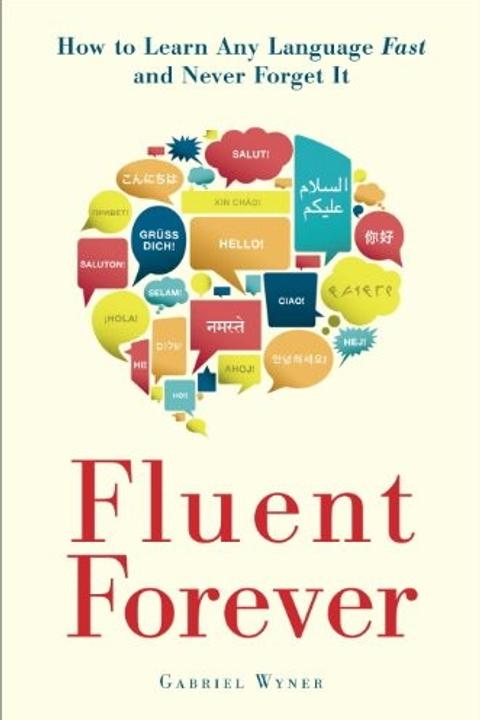
Fluent Forever by Gabriel Wyner: Summary & Notes
by Gabriel Wyner
In one sentence
Learn languages faster by training your ear first, using spaced repetition with personal connections, and never translating—think directly in the new language from day one.
Key takeaways
- Start with pronunciation—train your ear before memorizing vocabulary
- Use spaced repetition (Anki) to efficiently move information to long-term memory
- Make personal connections—images and memories stick better than translations
- Never translate—learn to think directly in the target language
- Learn the most frequent words first—625 words cover most daily conversation
- Immersion and input are essential—consume content in your target language
Summary
Easily the best book about language learning I've ever read.
I've tried multiple resources and methods to improve my own language skills in the past, and none of them came close to being this precise and actionable.
I'll be using the techniques described over the coming months.
Would highly recommend for anyone, new beginner or advanced alike.
At a high level, the techniques are:Learn pronunciation first.
Don’t translate.
Use spaced repetition systems.
Learn words.
Learn sentences.
Also detailed are the exact methods for creating the flashcards for each section required for the spaced repetition systems, as well as videos supplementing pronunciation techniques.
Who should read this
- Language learners frustrated with traditional methods
- Anyone wanting to learn a language efficiently
- Polyglots looking for better systems
- People who have "tried and failed" to learn languages
FAQ
What makes Fluent Forever different from other language methods?
Fluent Forever emphasizes: 1) Pronunciation first, not grammar. 2) Personal imagery instead of translations. 3) Spaced repetition for efficient memorization. 4) Thinking in the target language from day one. 5) Learning high-frequency words first.
Detailed Notes
Click to expand the full detailed notes →
Detailed Notes
Click to expand the full detailed notes →
Detailed Notes
Steps (Chapter 1)
- Learn pronunciation first.
- Don’t translate.
- Use spaced repetition systems.
How to Remember (Chapter 2)
Five Principles of Memory:
Make memories more memorable
- Maximize laziness
- Don’t review, recall
- Wait, wait! Don’t tell me!
- Rewrite the past
- Use Anki for spaced repetition
- Aim for 15-30 new cards per day, plus review (~30 minutes per day)
- Schedule your time and ideally tie it to another habit
- Scale back on new words if you miss a day (add 2-3)
- French tip: assume every final consonant is silent except for those consonants found in ‘careful’ (c,r,f,l)
Learning Sounds (Chapter 3)
- Three main challenges:
- Ear training, mouth training and eye training
- Ear training: use audible minimal pair testing (Fluent-Forever.com/chapter3)
- If you can hear all of the sounds in your language, then you might get surprised by the spelling of a word but never by the sound of a word
Train your mouth:
I’ve made a series of YouTube videos to help you get the pronunciation information you need (Fluent-Forever.com/chapter3)
- Use the IPA phonetic alphabet
- In general, you only need three pieces of information to make any sound: you need to know what to do with your tongue, with your lips, and with your vocal cords, and there aren’t that many options.
- In Appendix 4, I give you an IPA decoder chart. Any time you come across some weird sound you don’t understand, you can load up the Wikipedia article for your language and compare it to the chart. The chart will tell you what to do with your tongue, your lips, and your vocal cords
- If you don’t know how to pronounce a whole word, work your way backward.
Train your eyes:
- Don’t use spellings of words; use a combination of recordings and a phonetic alphabet, at least until the little French man in my head starts sounding very French
- Then I stop with the recordings and rely on my phonetic alphabet. If my language is very friendly, phonetically speaking, I’ll phase out my phonetic alphabet once I’m feeling (over)confident about my pronunciation
Learning Words (Chapter 4)
- Learn words from word frequency lists (start with 625 listed in Appendix 5)
- Use 2 games to create deep, multi sensory memories for words (combine spelling, sound, meaning and personal connection):
Game 1 - Spot the Differences: Finding Meaning Through Google Images
- Search for word in native language
- Switch to Basic Version at bottom of page
- Look for differences in what you expected and what you see (take 10-20 seconds to play)
- Then store one or two particularly good images in flashcard for that word
Game 2 - The Memory Game: Boosting Meaning Through Personal Connection
- Look for a personal memory related to the word
- Try to keep the word in mind rather than the translation - hybrid sentences are fine
- Use another game to remember gender:
Game 3 - The Mnemonic Imagery Game: How to Memorize Nonsensical Bits of Grammar
- Imagine all masculine nouns exploding
- Feminine nouns should catch fire
- Neuter items should shatter like glass
Learning Sentences (Chapter 5)
- Go from simple sentences (birdie go, doggie jump) to -ing forms (doggie jumping) to irregular past (birdies went) and is (daddy is big), then finally regular past tense verbs (doggie jumped) and present tense in third person (Daddy eats).
- All language learning follows this pattern
- Pick an example or two from grammar book and make flash card, then move on.
Ask yourself three questions:
- Do you see any new words here?
- Do you see any new word forms here?
- Is the word order surprising to you?
Then make flash cards based on these.
- Use declension chart to learn similar verb forms.
- Use Person-Action-Object mnemonics for adjectives - keep track of them on flashcards.
- Write about things you like, upload them to Lang-8, and get corrections - continue doing this.
- Put every correction into flash cards.
The Language Game (Chapter 6)
- Start with the top 1000 words in your new language.
- Then pick your own goals:
- 2000 words gets you 80% comprehension
- Add key words based on your interests
- Use a thematic vocabulary book (Barron makes best ones)
- Use Google Images to find quality example sentences and pictures for your words.
- Write example sentences and definitions, and get them corrected.
- Once you have enough vocabulary, add a monolingual dictionary to your toolbox.
Read a book
- First book should be familiar to you - try Harry Potter
- You’ll get 300-500 words from context alone
Listening comprehension: watch movies and TV
- TV is easier than film
- Start with something that’s not comedy - House or 24 are good
- Read Wikipedia overview of series or movie first
- Don’t use subtitles
Game of Taboo: only rule - no English (first language) allowed
- Use livemocha.com, busuu.com, mylanguageexchange.com or italki.com for partners for video chatting
- Take language holidays
- Immersion programs (Middlebury College)
Actionable Items
- Learned French in 1-hr per day plus weekend binges in 3 months, plus 7-8 weeks intensive immersion
- Without immersion, estimate 5-8 months with 30-45 minutes per day
- Look for books to get in Appendix 1 (grammar book, phrase book, frequency dictionary, pronunciation guide)
- Watch IPA videos here: https://fluent-forever.com/chapter3/
- Watch video here: https://fluent-forever.com/pronunciation-trainers/french/
- Use instructions at https://fluent-forever.com/gallery/ to make flashcards