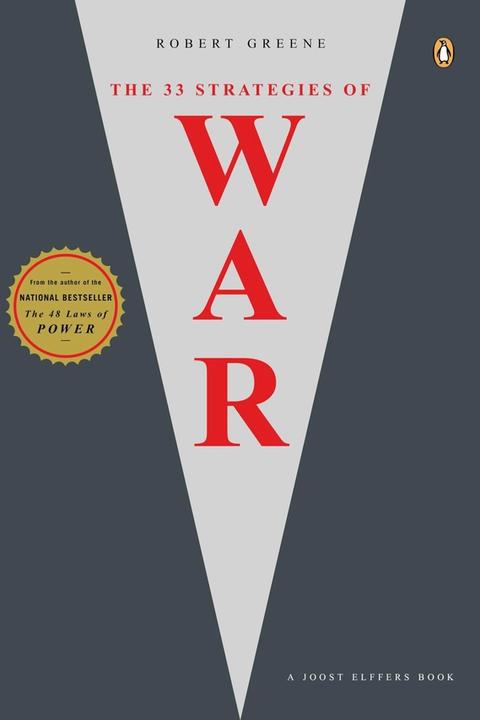
Greene's 33 War Strategies: Win Conflicts Without Fighting
by Robert Greene
Why read this book
- ⚔️ 33 battle-tested strategies from history's greatest commanders
- 💼 Apply military thinking to business competition and negotiations
- 🧠 Learn to think strategically and anticipate opponents' moves
- 📖 Examples from Alexander the Great, Napoleon, and modern CEOs
In one sentence
Apply military strategy to business and life with Robert Greene's 33 battle-tested tactics. From Napoleon to Sun Tzu, learn to think strategically, anticipate opponents' moves, and win conflicts before they begin.
Key takeaways
- Think strategically, not emotionally — separate your reactions from your responses.
- Know when to fight and when to retreat — choosing your battles is itself a strategy.
- Speed and surprise beat strength — the blitzkrieg principle applies to business and life.
- Control the narrative — perception management is as powerful as action.
- Study your enemy deeply — intelligence gathering prevents costly mistakes.
- Grand strategy > tactics — win the war, not just individual battles.
- Use unconventional methods — the expected move is often the weakest.
- Always have an exit strategy — know how to end things before you begin.
Summary
The 33 Strategies of War is Robert Greene's third major work, applying the tactical and strategic wisdom of military history to everyday conflicts — in business, relationships, and personal ambition.
Greene argues that life is defined by conflict. Whether we acknowledge it or not, we face rivals, obstacles, and opposition. The difference between winners and losers often comes down to strategic awareness: seeing the battlefield clearly, understanding human psychology, and knowing when and how to act.
The book is organized into five parts: Self-Directed Warfare (mastering yourself), Organizational Warfare (leading teams), Defensive Warfare (protecting what you have), Offensive Warfare (going on the attack), and Unconventional Warfare (fighting dirty when necessary).
Each strategy is illustrated with historical examples — from Napoleon and Sun Tzu to Muhammad Ali and Lyndon Johnson — showing how principles of war translate into principles of power.
Reflections
Sometimes it's harder to jump from war strategies to life, but it's possible nonetheless. The book gives an overview of major war strategies, and how they can be applied to life.
I enjoyed the format of the book — strategy followed by historical examples — just like I enjoy Robert Greene's other books.
I would read 48 Laws of Power and Mastery first, but this is another insightful, thorough book by Greene. It's dense at 500+ pages, but the historical examples make it engaging.
Who should read this
- Entrepreneurs and founders navigating competitive markets
- Leaders and managers dealing with organizational politics
- Anyone in a competitive field — law, sales, finance, sports
- Fans of Robert Greene who want deeper strategic frameworks
- History buffs who enjoy learning through military examples
- People facing conflict in their career or personal life
Favorite quotes
- If there is an ideal to aim for, it should be that of the strategic warrior, the man or woman who manages difficult situations and people through deft and intelligent maneuver.
- Our successes and failures in life can be traced to how well or how badly we deal with the inevitable conflicts that confront us in society.
- Look at things as they are, not as your emotions color them.
- Judge people by their actions.
- Depend on your own arms.
- True strategy is psychological — a matter of intelligence, not material force.
- Having superior strategies at your fingertips will give your maneuvers irresistible force. As Sun-tzu says, 'Being unconquerable lies with yourself.'
- Worship Athena, not Ares.
- In war, strategy is the art of commanding the entire military operation. Tactics is the skill of forming up the army for battle itself.
- The greatest generals in history elevate themselves above the battlefield.
FAQ
What are all 33 strategies of war?
PART I — SELF-DIRECTED WARFARE
1. Declare war on your enemies
2. Do not fight the last war
3. Amidst the turmoil, keep your presence of mind
4. Create a sense of urgency and desperation
PART II — ORGANIZATIONAL WARFARE
5. Avoid the groupthink trap
6. Segment your forces
7. Transform your war into a crusade
PART III — DEFENSIVE WARFARE
8. Pick your battles carefully
9. Turn the tables
10. Create a threatening environment
11. Trade space for time
12. Lose battles but win the war
13. Know your enemy
PART IV — OFFENSIVE WARFARE
14. Overwhelm resistance with speed and suddenness
15. Control the dynamic
16. Hit them where it hurts
17. Defeat them in detail
18. Expose and attack your enemy's soft flank
19. Envelop the enemy
20. Maneuver them into weakness
21. Negotiate while advancing
22. Know how to end things
PART V — UNCONVENTIONAL WARFARE
23. Weave a seamless blend of fact and fiction
24. Take the line of least expectation
25. Occupy the moral high ground
26. Deny them targets
27. Seem to work for the interests of others
28. Give your rivals enough rope to hang themselves
29. Take small bites
30. Penetrate their minds
31. Destroy from within
32. Dominate while seeming to submit
33. Sow uncertainty and panic through terror
How does this compare to The 48 Laws of Power?
48 Laws is about social/political power. 33 Strategies is about conflict and competition. There's overlap, but 33 Strategies is more tactical and situational.
Is this book manipulative?
Like all Greene books, it's amoral — it describes how power and conflict work, not how they should work. Use it ethically.
Do I need military knowledge to understand it?
No. Greene explains every example clearly. The military history is illustrative, not assumed.
What's the best Robert Greene book to start with?
Most people start with 48 Laws of Power or Mastery. 33 Strategies is better once you're familiar with Greene's style.
Is this book still relevant today?
Absolutely. The principles of strategy are timeless — they apply to business, negotiations, and any competitive environment.
How long does it take to read?
It's 500+ pages and dense. Expect 15-20 hours, or treat it as a reference book to dip into.
Detailed Notes
Click to expand the full detailed notes →
Detailed Notes
Click to expand the full detailed notes →
Notes
Preface
- If there is an ideal to aim for, it should be that of the strategic warrior, the man or woman who manages difficult situations and people through deft and intelligent maneuver.
- Our successes and failures in life can be traced to how well or how badly we deal with the inevitable conflicts that confront us in society.
- The following are six fundamental ideals you should aim for in transforming yourself into a strategic warrior in daily life.
- Look at things as they are, not as your emotions color them.
- The only remedy is to be aware that the pull of emotion is inevitable, to notice it when it is happening, and to compensate for it. When you have success, be extra wary. When you are angry, take no action. When you are fearful, know you are going to exaggerate the dangers you face.
- Judge people by their actions.
- Depend on your own arms.
- But true strategy is psychological--a matter of intelligence, not material force. Everything in life can be taken away from you and generally will be at some point.
- Having superior strategies at your fingertips will give your maneuvers irresistible force. As Sun-tzu says, “Being unconquerable lies with yourself”.
- Worship Athena, not Ares.
- Ares was the god of war in its direct and brutal form. The Greeks despised Ares and worshipped Athena, who always fought with the utmost intelligence and subtlety. Your interest in war is not the violence, the brutality, the waste of lives and resources, but the rationality and pragmatism it forces on us and the ideal of winning without bloodshed.
- Elevate yourself above the battlefield.
- In war, strategy is the art of commanding the entire military operation. Tactics, on the other hand, is the skill of forming up the army for battle itself and dealing with the immediate needs of the battlefield.
- To have the power that only strategy can bring, you must be able to elevate yourself above the battlefield, to focus on your long-term objectives, to craft an entire campaign, to get out of the reactive mode that so many battles in life lock you into.
- Keeping your overall goals in mind, it becomes much easier to decide when to fight and when to walk away.
- Spiritualize your warfare.
- Every day you face battles--that is the reality for all creatures in their struggle to survive. But the greatest battle of all is with yourself--your weaknesses, your emotions, your lack of resolution in seeing things through to the end. You must declare unceasing war on yourself. As a warrior in life, you welcome combat and conflict as ways to prove yourself, to better your skills, to gain courage, confidence, and experience.
Part I: Self-Directed Warfare
- To become a true strategist, you must become aware of the weakness and illness that can take hold of the mind. You must declare war on yourself to make yourself move forward.
Declare War on Your Enemies: The Polarity Strategy
- Learn to identify your enemies, and then inwardly declare war.
- Your enemies, like the opposite poles of a magnet, can fill you with purpose and direction.
- The more clearly you define who you do not want to be, the clearer your own sense of identity.
- See yourself as a fighter, surrounded by enemies. Constant battle keeps you strong and alert.
- Do not be lured by the need to be liked: better to be respected, even feared.
Keys to Warfare:
- Understand: people tend to be vague and slippery because it is safer than outwardly committing to something. If you are the boss, they will mimic your ideas. Their agreement is often pure courtiership. Get them emotional; people are usually more sincere when they argue. If you pick an argument with someone and he keeps on mimicking your ideas, you may be dealing with a chameleon, a particularly dangerous type.
- A tough opponent will bring out the best in you.
Reversal:
- Always keep the search for and use of enemies under control. It is clarity you want, not paranoia. It is the downfall of many tyrants to see an enemy in everyone. They lose their grip on reality and become hopelessly embroiled in the emotions their paranoia churns up.
Do Not Fight the Last War: The Guerrilla-War-of-the-Mind Strategy
- What most often weighs you down and brings you misery is the past, in the form of unnecessary attachments, repetitions of tired formulas, and the memory of old victories and defeats. You must consciously wage war against the past and force yourself to react to the present moment.
- Never take it for granted that your past successes will continue into the future.
Keys to Warfare
- Understand: the greatest generals, the most creative strategists, stand out not because they have more knowledge but because they are able, when necessary, to drop their preconceived notions and focus intensely on the present moment. That is how creativity is sparked and opportunities are seized.
- It can be valuable to analyze what went wrong in the past, but it is far more important to develop the capacity to think in the moment. In that way you will make far fewer mistakes to analyze.
- The first step is simply to be aware of the process and of the need to fight it. The second is to adopt a few tactics that might help you to restore the mind's natural flow.
- Reexamine all your cherished beliefs and principles.
- Your only principle, similarly, should be to have no principles.
- Erase the memory of the last war.
- Attention to the details of the present is by far the best way to crowd out the past and forget the last war.
- Keep the mind moving.
- Superior strategists see things as they are. They are highly sensitive to dangers and opportunities.
- Great strategists do not act according to preconceived ideas; they respond to the moment, like children.
- Absorb the spirit of the times.
- Constantly adapt and change, and you will avoid the pitfalls of your previous wars. Just when people feel they know you, you will change.
- Reverse course.
- Sometimes you must reverse course, break free from the hold of the past. Do the opposite of what you would normally do in a given situation.
- Act in a novel manner in relationships to break up the dynamic.
Amidst the Turmoil of Events, Do Not Lose Your Presence of Mind: The Counterbalance Strategy
- You must actively resist the emotional pull of the moment, maintaining your mental powers whatever the circumstances.
- Make your mind tougher by exposing it to adversity. Learn to detach yourself.
The Hyperaggressive Tactic
- In moments of turmoil and trouble, you must force yourself to be more determined and aggressive. Any mistakes you make can be rectified with more aggression.
The Detached-Buddha Tactic
- Presence of mind is the ability to detach yourself and see the whole battlefield with clarity. What gives you that distance is preparation, mastering the details beforehand. Let people think your Buddha-like detachment comes from some mysterious source. The less they understand you, the better.
Keys to Warfare
- What makes your mind stronger, and more able to control your emotions, is internal discipline and toughness.
- No one can teach you this skill. It can only come through practice, experience, and even a little suffering.
- To toughen your mind:
- Expose yourself to conflict.
- It is better to confront your fears than to ignore them or tamp them down.
- The more conflicts and difficult situations you put yourself through, the more battle-tested your mind will be.
- Be self-reliant.
- Dependency makes you vulnerable to all kinds of emotions.
- We tend to overestimate other people’s abilities, and we tend to underestimate our own. Compensate for this by trusting yourself more, and others less.
- Remember, though, that being self-reliant does not mean burdening yourself with petty details.
- Suffer fools gladly.
- Your time and energy are limited, and you must learn how to preserve them.
- Instead, think of fools as you think of children, or pets, not important enough to affect your mental balance.
- Crowd out feelings of panic by focusing on simple tasks.
- Unintimidate yourself.
- See the person, not the myth. Imagine him or her as a child, as someone riddled with insecurities.
- Develop yourFingerspitzengefuhl(fingertip feel).
- Presence of mind depends not only on your mind's ability to come to your aid in difficult situations but also on the speed with which this happens.
- There are things you can do to help you respond faster and bring out that intuitive feel that all animals possess. Deep knowledge of the terrain will let you process information faster than your enemy, a tremendous advantage. Getting a feel for the spirit of men and material, thinking your way into them instead of looking at them from outside, will help to put you in a different frame of mind.
- Get your mind into the habit of making lightning-quick decisions, trusting your fingertip feel. Your mind will advance in a kind of mental blitzkrieg, moving past your opponents before they realize what has hit them.
Create a Sense of Urgency and Desperation: The Death-Ground Strategy
- You are your own worst enemy. You waste precious time dreaming of the future instead of engaging in the present. Since nothing seems urgent to you, you are only half involved in what you do. The only way to change is through action and outside pressure. Put yourself in situations where you have too much at stake to waste time or resources--if you cannot afford to lose, you won't. Cut your ties to the past; enter unknown territory where you must depend on your wits and energy to see you through. Place yourself on "death ground," where your back is against the wall and you have to fight like hell to get out alive.
The No-Return Tactic
- In the back of your mind, you keep an escape route, a crutch, something to turn to if things go bad.
- You may see this fallback as a blessing, but it is in fact a curse. It divides you. Because you think you have options, you need involve yourself deeply enough in one thing to do it thoroughly, and you never quite get what you want. Sometimes you need to burn the ships.
The Death-at-Your-Heels Tactic
- You must think of death in order to embrace your limited days left. Make the most of them and live with a sense of urgency.
Keys to Warfare
- Put yourself in a comfortable situation, and we may grow bored or tired. Put yourself in a high-stakes situation, and the dynamic changes. You get a surge of energy, and your mind focuses.
- Use the following five actions to put yourself on a psychological death ground:
- Stake everything on a single throw.
- It is better to take on one daunting challenge than diffuse our efforts across many.
- Act before you are ready.
- Do this often and you will develop your ability to think and act fast.
- Enter new waters.
- Leave stale relationships and comfortable situations behind, and cut your ties to the past.
- Make it “you against the world."
- A fighting spirit needs a little edge, some anger and hatred to fuel it. Get aggressive and irritate and infuriate people directly.
- Keep yourself restless and unsatisfied.
- Make risk a constant practice; never let yourself settle down.
- Life has more meaning in the face of death.
Reversal
- Never attack enemies with nothing to lose.
- Conversely, attacking enemies when morale is low gives you the advantage.
- Always try to lower the other side’s sense of urgency.
Part II: Organizational (Team) Warfare
- It is the structure of your army - the chain of command and the relationship of the parts to the whole - that will give your strategies force.
- You must build speed and mobility into the structure of your army.
- That means having a single authority on top, going soldiers a sense of the overall goal to be accomplished and the latitude to take action to meet that goal. It means motivating soldiers, creating an overall esprit du corps that gives momentum.
- Before formulating a strategy or taking action, understand the structure of your group.
Avoid the Snares of GroupThink: The Command-and-Control Strategy
- The problem in leading any group is that people inevitably have their own agendas. If you are too authoritarian, they will resent you and rebel in silent ways. If you are too easygoing, they will revert to their natural selfishness and you will lose control. You have to create a chain of command in which people do not feel constrained by your influence yet follow your lead.
- Create a sense of participation, but do not fall into Groupthink.
- A proper chain of command, and the control it brings you, is not an accident; it is your creation, a work of art that requires constant attention and care.
Keys to Warfare
- This is the game you must play: Do whatever you can to pressure unity of command. At the same time, hide your tracks. Work behind the scenes; make the group feel involved in your decisions.
- A critical step in creating an efficient chain of command is assembling a skilled team that shares your goals and values.
- In creating this team, you are looking for people who make up for your deficiencies, who have the skills you lack.
- Be careful in assembling this team that you are not seduced by expertise and intelligence. Character, the ability to work under you and with the rest of the team, and the capacity to accept responsibility and think independently are equally key.
- The single greatest risk to your chain of command comes from the political animals in the group. Try to weed them out before they arrive.
- Finally, pay attention to the orders themselves--their form as well as their substance. Vague orders are worthless.
- On the other hand, if your commands are too specific and too narrow, you will encourage people to behave like automatons and stop thinking for themselves--which they must do when the situation requires it. Erring in neither direction is an art.
Segment Your Forces: The Controlled-Chaos Strategy
- Speed and adaptability are critical elements in war, and come from flexible organization.
- Decentralize your army, segment into teams, and let go a little to gain mobility.
- Give your different corps clear missions that fit your strategic goals, then let them accomplish them as they see fit.
Keys to Warfare
- The essence of strategy is not to carry out a brilliant plan that proceeds in steps; it is to put yourself in situations where you have more options than the enemy does.
- The key to the mission command is an overall group philosophy. This can be built around the cause you are fighting for or a belief in the evil of the enemy you face. It can also include the style of warfare--defensive, mobile, ruthlessly aggressive--that best suits it. You must bring the group together around this belief. Then, through training and creative exercises, you must deepen its hold on them, infuse it into their blood.
Transform Your War into a Crusade: Morale Strategies
- The secret to motivating people and maintaining their morale is to get them to think less about themselves and more about the group. Involve them in a cause, a crusade against a hated enemy. Make them see their survival as tied to the success of the army as a whole.
- Lead from the front: let your soldiers see you in the trenches, making sacrifices for the cause.
The Art of Man Management
- To create the best group dynamic, follow as many of the following steps as possible:
- Step 1: Unite your troops around a cause. Make them fight for an idea.
- The cause can be anything you wish, but you should represent it as progressive: it fits the times, it is on the side of the future, so it is destined to succeed.
- Step 2: Keep their bellies full.
- People cannot stay motivated if their material needs go unmet.
- Step 3: Lead from the front.
- Step 4: Concentrate theirch’i.
- Idleness has a terrible effect on chi’i.
- Keep your soldiers busy, acting for a purpose, moving in a direction.
- Step 6: Mix harshness and kindness.
- The key to man management is a balance of punishment and reward.
- Step 7: Build the group myth.
- The armies with the highest morale are armies that have been tested in battle. Soldiers who have fought alongside one another through many campaigns forge a kind of group myth based on their past victories.
- To generate this myth, you must lead your troops into as many campaigns as you can. It is wise to start out with easy battles that they can win, building up their confidence.
- Step 8: Be ruthless with grumblers.
- Above all else, pay attention to your staff.
- Morale is contagious, and you, as leader, set the tone.
- If aiming at emotions, you must aim indirectly: get them to laugh or cry over something that seems unrelated to the issue at hand. Emotions are contagious - they bring people together and make them bond.
Part III: Defensive Warfare
- To fight defensively, you must make the most of your resources, fighting with perfect economy and only battles that are necessary.
- Second, you must know how and when to retreat, luring an aggressive enemy into an imprudent attack. Then, when exhausted, launch a vicious counterattack.
- To fight this way, you must master the arts of deception.
Pick Your Battles Carefully: The Perfect-Economy Strategy
- You must know your limits and pick your battles carefully.
- Pyrrhic victories are much more common than you might think.
- No person or group is completely weak or strong. You must make sure to assess and attack weaknesses.
Keys to Warfare
- Creativity gives you an edge over enemies dependent on technology; you will learn more, be more adaptable, and you will outsmart them.
- The next time you launch a campaign, try an experiment: think deeply about what you have first, then, let your plans and goals blossom.
- Do not mistake cheapness for perfect economy.
- Several tactics are key to fighting economically:
- The use of deception.
- Choosing opponents you can beat.
- Look for new opportunities and build momentum.
Reversal
- There is no value in fighting without economy, but it is always wise to make your opponent waste as many resources as possible.
Turn the Tables: The Counterattack Strategy
- Moving first will often put you at a disadvantage: you are exposing your strategy and limiting your options.
- Instead, let the other side move first, or bait opponents into rash attacks that will leave them in a weak position.
- Playing weak and then catching them off guard with an attack is also a good tactic.
- Make jujitsu your style in almost everything you do.
Keys to Warfare
- The first step in mastering the counterattack is to master yourself, and particularly the tendency to grow emotional in conflict.
- The key to the successful counterattack is staying calm while your opponent gets frustrated and irritable.
- Mirroring people - going back to them just what they give to you - is a powerful method of counterattack.
- In general, encouraging people to follow their natural direction, to give in to their greed or neuroses, will die you more control over them than active resistance will.
- The modern dilemma is that taking the offensive is unacceptable today--attack and your reputation will suffer, you will find yourself politically isolated, and you will create enemies and resistance. The counterattack is the answer. Let your enemy make the first move, then play the victim.
Create a Threatening Presence: Deterrence Strategies
- The best way to fight off aggressors is to keep them from attacking you in the first place. To accomplish this you must create the impression of being more powerful than you are. Build up a reputation: You're a little crazy. Fighting you is not worth it. You take your enemies with you when you lose.
- This art of deterrence rests on three basic facts about war and human nature: First, people are more likely to attack you if they see you as weak or vulnerable. Second, they cannot know for sure that you're weak; they depend on the signs you give out, through your behavior both present and past. Third, they are after easy victories, quick and bloodless. That is why they prey on the vulnerable and weak.
- The following are five basic methods of deterrence and reverse intimidation. You can use them all in offensive warfare, but they are particularly effective in defence:
- Surprise with a bold maneuver.
- This will have two positive effects: First, they will tend to think your move is backed up by something real--they will not imagine you could be foolish enough to do something audacious just for effect. Second, they will start to see strengths and threats in you that they had not imagined.
- Reverse the threat.
- Turn the tables with a sudden move designed to scare them. Threaten something they value. You needn’t go too far, just inflict a little pain to indicate you are capable of worse.
- Seem unpredictable and irrational.
- In this instance you do something suggesting a slightly suicidal streak, as if you felt you had nothing to lose. You show that you are ready to take your enemies down with you, destroying their reputations in the process. (This is particularly effective with people who have a lot to lose themselves--powerful people with sterling reputations.)
- Play on people's natural paranoia.
- Instead of threatening your opponents openly, you take action that is indirect and designed to make them think. This might mean using a go-between to send them a message--to tell some disturbing story about what you are capable of. Or maybe you “inadvertently” let them spy on you, only to hear something that should give them cause for concern.
- Establish a frightening reputation.
- This reputation can be for any number of things: being difficult, stubborn, violent, ruthlessly efficient. Build up that image over the years and people will back off from you, treating you with respect and a little fear.
Trade Space for Time: The Nonengagement Strategy
- Retreat in the face of a strong enemy is a sign not of weakness but of strength. By resisting the temptation to respond to an aggressor, you buy yourself valuable time--time to recover, to think, to gain perspective. Let your enemies advance; time is more important than space. By refusing to fight, you infuriate them and feed their arrogance. They will soon overextend themselves and start making mistakes.
Keys to Warfare
- Your task as a strategist is simple: to see the differences between yourself and other people, to understand yourself, your side, and the enemy as well as you can, to get more perspective on events, to know things for what they are.
Part IV: Offensive Warfare
- The greatest dangers in war, and in life, come from the unexpected: people do not respond the way you had thought they would, events mess up your plans and produce confusion, circumstances are overwhelming.
- In strategy, the discrepancy between what you want to happen and what does happen is called friction.
- The idea behind conventional offensive warfare is simple: by attacking the other side first, you create your own circumstances before friction can creep in.
- To be successful at offensive warfare, you must plan in intense detail, thinking in terms of the whole campaign, not individual battles.
Lose Battles but Win the War: Grand Strategy
- Grand strategy is the art of looking beyond the battle and calculating ahead. It requires focusing on the ultimate goal, and considering the politics and long-term consequences of what you do.
- To become a grand strategist in life, you must follow the path of Alexander. First, clarify your life--decipher your own personal riddle--by determining what it is you are destined to achieve, the direction in which your skills and talents seem to push you. Visualize yourself fulfilling this destiny in glorious detail.
- Ignore the conventional wisdom about what you should or should not be doing. It may make sense for some, but that does not mean it bears any relation to your own goals and destiny. You need to be patient enough to plot several steps ahead--to wage a campaign instead of fighting battles.
- Your task as a grand strategist is to extend your vision in all directions--not only looking further into the future but also seeing more of the world around you, more than your enemy does.
Keys to Warfare
- The first step was to think beyond the immediate battle. Supposing you won victory, where would it leave you--better off or worse? To answer that question, the logical step was to think ahead, to the third and fourth battles on, which connected like links in a chain. The result was the concept of the campaign, in which the strategist sets a realistic goal and plots several steps ahead to get there.
- Grand strategy has four main principles. The more you can incorporate these principles into your plans, the better the results:
- Focus on your greater goal, your destiny.
- What have distinguished all history's grand strategists and can distinguish you, too, are specific, detailed, focused goals. Contemplate them day in and day out, and imagine how it will feel to reach them and what reaching them will look like. By a psychological law peculiar to humans, clearly visualizing them this way will turn into a self-fulfilling prophecy.
- Your goals must be rooted in reality. If they are simply beyond your means, essentially impossible for you to realize, you will grow discouraged, and discouragement can quickly escalate into a defeatist attitude. On the other hand, if your goals lack a certain dimension and grandeur, it can be hard to stay motivated. Do not be afraid to be bold.
- Widen your perspective.
- Grand strategy is a function of vision, of seeing further in time and space than the enemy does.
- Your task as a grand strategist is to force yourself to widen your view, to take in more of the world around you, to see things for what they are and for how they may play out in the future, not for how you wish them to be.
- Sever the roots.
- In a society dominated by appearances, the real source of a problem is sometimes hard to grasp. To work out a grand strategy against an enemy, you have to know what motivates him or is the source of his power - the roots.
- Take the indirect route to your goal.
- The greatest danger you face in strategy is losing the initiative and finding yourself constantly reacting to what the other side does. The solution, of course, is to plan ahead but also to plan subtly--to take the indirect route. Preventing your opponent from seeing the purpose of your actions gives you an enormous advantage.
- Whenever anything goes wrong, it is human nature to blame this person or that. Let other people engage in such stupidity, led around by their noses, seeing only what is immediately visible to the eye. You see things differently. When an action goes wrong--in business, in politics, in life--trace it back to the policy that inspired it in the first place. The goal was misguided.
- This means that you yourself are largely the agent of anything bad that happens to you. With more prudence, wiser policies, and greater vision, you could have avoided the danger. So when something goes wrong, look deep into yourself--not in an emotional way, to blame yourself or indulge your feelings of guilt, but to make sure that you start your next campaign with a firmer step and greater vision.
Know Your Enemy: The Intelligence Strategy
- The target of your strategies should be less the army you face than the mind of the man or woman who runs it. If you understand how that mind works, you have the key to deceiving and controlling it.
- Our natural tendency is to see other people as mere reflections of our own desires and values.
- The best way to find the leader's weaknesses is not through spies but through the close embrace. Behind a friendly, even subservient front, you can observe your enemies, get them to open up and reveal themselves. Get inside their skin; think as they think. Once you discover their vulnerability--an uncontrollable temper, a weakness for the opposite sex, a gnawing insecurity--you have the material to destroy them.
Keys to Warfare
- The greatest power you could have in life would come neither from limitless resources nor even consummate skill in strategy. It would come from clear knowledge of those around you--the ability to read people like a book.
- In general, it is easier to observe people in action, particularly in moments of crisis. Those are the times when they either reveal their weakness or struggle so hard to disguise it that you can see through the mask.
- A warning: never rely on one spy, one source of information, no matter how good. You risk being played or getting slanted, one-sided information.
- Finally, the enemy you are dealing with is not an inanimate object that will simply respond in an expected manner to your strategies. Your enemies are constantly changing and adapting to what you are doing. Innovating and inventing on their own, they try to learn from their mistakes and from your successes. So your knowledge of the enemy cannot be static. Keep your intelligence up to date, and do not rely on the enemy's responding the same way twice.
Reversal
- Even as you work to know your enemies, you must make yourself as formless and difficult to read as possible. Since people really only have appearances to go on, they can be readily deceived. Act unpredictably now and then.
Overwhelm Resistance with Speed and Suddenness: The Blitzkrieg Strategy
- In a world in which many people are indecisive and overly cautious, the use of speed will bring you untold power.
- This strategy works best with a setup, a lull - your unexpected action catches your enemy off guard.
- We live in a world in which speed is prized above almost all else, and acting faster than the other side has itself become the primary goal. But most often people are merely in a hurry, acting and reacting frantically to events, all of which makes them prone to error and wasting time in the long run. In order to separate yourself from the pack, to harness a speed that has devastating force, you must be organized and strategic. First, you prepare yourself before any action, scanning your enemy for weaknesses. Then you find a way to get your opponents to underestimate you, to lower their guard. When you strike unexpectedly, they will freeze up. When you hit again, it is from the side and out of nowhere. It is the unanticipated blow that makes the biggest impact.
Keys to Warfare
- Velocity creates a sense of vitality. Moving with speed means there is less time for you and your army to make mistakes. It also creates a bandwagon effect: more and more people admiring your boldness, will decide to join forces with you.
- This strategy can be particularly devastating for those who are particularly hesitant or afraid of making mistakes, or those who have divided leadership or internal cracks.
Reversal
- Appearing slow can be an advantage, particularly as a setup.
- In general, when facing a fast enemy, the only true defence is to be faster.
Control the Dynamic: Forcing Strategies
- People are constantly struggling to control you--getting you to act in their interests, keeping the dynamic on their terms. The only way to get the upper hand is to make your play for control more intelligent and insidious.
- Shift the conflict to terrain of your choice, altering the pace and stakes to suit you. Maneuver to control your opponents' minds, pushing their emotional buttons, and compelling them to make mistakes. If necessary, let them feel they are in control in order to get them to lower their guard.
The Art of Ultimate Control
- The superior strategist understands that it is impossible to control exactly how an enemy will respond to this move or that. To attempt to do so will only lead to frustration and exhaustion. There is too much in war and in life that is unpredictable. But if the strategist can control the mood and mind-set of his enemies, it does not matter exactly how they respond to his maneuvers. If he can make them frightened, panicky, overly aggressive, and angry, he controls the wider scope of their actions and can trap them mentally before cornering them physically.
- Control can be aggressive or passive. It can be an immediate push on the enemy, making him back up and lose the initiative. It can be playing possum, getting the enemy to lower his guard, or baiting him into a rash attack. The artist of control weaves both of these into a devastating pattern--hitting, backing off, baiting, overwhelming.
- There are four basic principles of the art:
- Keep them on their heels.
- Before the enemy makes a move, before the element of chance or the unexpected actions of your opponents can ruin your plans, you make an aggressive move to seize the initiative. You then keep up a relentless pressure, exploiting this momentary advantage to the fullest.
- Shift the battlefield.
- An enemy naturally wants to fight you on familiar terrain. Terrain in this sense means all of the details of the battle--the time and place, exactly what is being fought over, who is involved in the struggle, and so on. By subtly shifting your enemies into places and situations that are not familiar to them, you control the dynamic.
- Compel mistakes.
- Your enemies depend on executing a strategy that plays to their advantages, that has worked in the past. Your task is twofold: to fight the battle in such a way that they cannot bring their strength or strategy into play and to create such a level of frustration that they make mistakes in the process.
- Assume passive control.
- The ultimate form of domination is to make those on the other side think they are the ones in control. Believing they are in command, they are less likely to resist you or become defensive. You create this impression by moving with the energy of the other side, giving ground but slowly and subtly diverting them in the direction you desire. It is often the best way to control the overly aggressive and the passive-aggressive.
- To control the dynamic, you must be able to control yourself and your emotions. Getting angry and lashing out will only limit your options. And in conflict, fear is the most debilitating emotion of all.
- Before anything else you must lose your fear--of death, of the consequences of a bold maneuver, of other people's opinion of you. That single moment will suddenly open up vistas of possibilities. And in the end whichever side has more possibilities for positive action has greater control.
Hit Them Where it Hurts: The Center-of-Gravity Strategy
- Everyone has a source of power on which he or she depends. When you look at your rivals, search below the surface for that source, the center of gravity that holds the entire structure together. That center can be their wealth, their popularity, a key position, a winning strategy. Hitting them there will inflict disproportionate pain. Find what the other side most cherishes and protects--that is where you must strike.
Keys to Warfare
- The key is analyzing the enemy force to determine its centers of gravity. In looking for those centers, it is crucial not to be misled by the intimidating or dazzling exterior, mistaking the outward appearance for what sets it in motion. You will probably have to take several steps, one by one, to uncover this ultimate power source, peeling away layer after layer.
- To find a group's center of gravity, you must understand its structure and the culture within which it operates. If your enemies are individuals, you must fathom their psychology, what makes them tick, the structure of their thinking and priorities.
- It is almost always strategically wise to disrupt your enemy's lines of communication; if the parts cannot communicate with the whole, chaos ensues.
- Your enemy's center of gravity can be something abstract, like a quality, concept, or aptitude on which he depends: his reputation, his capacity to deceive, his unpredictability. But such strengths become critical vulnerabilities if you can make them unattractive or unusable.
Defeat Them in Detail: The Divide-and-Conquer Strategy
- When you look at your enemies, do not be intimidated by their appearance. Instead look at the parts that make up the whole. By separating the parts, sowing dissension and division from within, you can weaken and bring down even the most formidable foe.
- In setting up your attack, work on their minds to create internal conflict. The joints are the weakest part of any structure.
- The best way to make an enemy divide is to occupy the centre.
- Think of battle or conflict as existing on a kind of chessboard. The chessboard's center can be physical--an actual place like Marathon--or more subtle and psychological: the levers of power within a group, the support of a critical ally, a troublemaker at the eye of the storm. Take the centre of the chessboard and the enemy will naturally break into parts, trying to hit you from more than one side.
- To make people join you, separate them from their past. When you size up your targets, look for what connects them to the past, the source of their resistance to the new.
- A joint is the weakest part of any structure. Break it and you divide people internally, making them vulnerable to suggestion and change. Divide their minds in order to conquer them.
Keys to Warfare
- The divide-and-conquer strategy has never been more effective than it is today: cut people off from their group--make them feel alienated, alone, and unprotected--and you weaken them enormously.
- Divide and rule is a powerful strategy for governing any group. It is based on a key principle: within any organization people naturally form smaller groups based on mutual self-interest--the primitive desire to find strength in numbers. These subgroups form power bases that, left unchecked, will threaten the organization as a whole.
- The solution is to divide to rule. To do so you must first establish yourself as the center of power; individuals must know they need to compete for your approval. There has to be more to be gained by pleasing the leader than by trying to form a power base within the group.
- The divide-and-rule strategy is invaluable in trying to influence people verbally. Start by seeming to take your opponents' side on some issue, occupying their flank. Once there, however, create doubt about some part of their argument, tweaking and diverting it a bit. This will lower their resistance and maybe create a little inner conflict about a cherished idea or belief. That conflict will weaken them, making them vulnerable to further suggestion and guidance.
Expose and Attack Your Opponent’s Soft Flank: The Turning Strategy
- When you attack people directly, you stiffen their resistance and make your task that much harder. There is a better way: distract your opponents' attention to the front, then attack them from the side, where they least expect it.
- Individuals often show their flank, signal their vulnerability, by its opposite, the front they show most visibly to the world.
- Life is full of hostility--some of it overt, some clever and under-handed. Conflict is inevitable; you will never have total peace.
- At all cost you must gain control of the impulse to fight your opponents directly. Instead occupy their flank. Disarm them and make them your ally; you can decide later whether to keep them on your side or to exact revenge. Taking the fight out of people through strategic acts of kindness, generosity, and charm will clear your path, helping you to save energy for the fights you cannot avoid.
Keys to Warfare
- The people who win true power in the difficult modern world are those who have learned indirection. They know the value of approaching at an angle, disguising their intentions, lowering the enemy's resistance, hitting the soft, exposed flank instead of butting horns. Rather than try to push or pull people, they coax them to turn in the direction they desire. This takes effort but pays dividends down the road in reduced conflict and greater results.
- The key to any flanking maneuver is to proceed in steps. Your initial move cannot reveal your intentions or true line of attack.
- When people present their ideas and arguments, they often censor themselves, trying to appear more conciliatory and flexible than is actually the case. If you attack them directly from the front, you end up not getting very far, because there isn't much there to aim at. Instead try to make them go further with their ideas, giving you a bigger target. Do this by standing back, seeming to go along, and baiting them into moving rashly ahead. (You can also make them emotional, pushing their buttons, getting them to say more than they had wanted to.) They will expose themselves on a weak salient, advancing an indefensible argument or position that will make them look ridiculous. The key is never to strike too early. Give your opponents time to hang themselves.
- The more subtle and indirect your maneuvers in life, the better.
- The ultimate evolution of strategy is toward more and more indirection. An opponent who cannot see where you are heading is at a severe disadvantage.
Envelop the Enemy: The Annihilation Strategy
- People will use any kind of gap in your defenses to attack you or revenge themselves on you. So offer no gaps. The secret is to envelop your opponents--create relentless pressure on them from all sides, dominate their attention, and close off their access to the outside world. Make your attacks unpredictable to create a vaporous feeling of vulnerability. Finally, as you sense their weakening resolve, crush their willpower by tightening the noose. The best encirclements are psychological--you have surrounded their minds.
Keys to Warfare
- There are many ways to envelop your opponents, but perhaps the simplest is to put whatever strength or advantage you naturally have to maximum use in a strategy of enclosure.
- To envelop your enemies, you must use whatever you have in abundance. If you have a large army, use it to create the appearance that your forces are everywhere, an encircling pressure.
- Remember: the power of envelopment is ultimately psychological. Making the other side feel vulnerable to attack on many sides is as good as enveloping them physically.
- Often, in fact, less is more here: too many blows will give you a shape, a personality--something for the other side to respond to and develop a strategy to combat. Instead seem vaporous. Make your maneuvers impossible to anticipate.
- The best encirclements are those that prey on the enemy's preexisting, inherent vulnerabilities. Be attentive, then, to signs of arrogance, rashness, or other psychological weakness.
- The impetuous, violent, and arrogant are particularly easy to lure into the traps of envelopment strategies: play weak or dumb and they will charge ahead without stopping to think where they're going.
Reversal
- The danger of envelopment is that unless it is completely successful, it may leave you in a vulnerable position.
Maneuver Them Into Weakness: The Ripening-for-the-Sickle Strategy
- No matter how strong you are, fighting endless battles with people is exhausting, costly, and unimaginative. Wise strategists generally prefer the art of maneuver: before the battle even begins, they find ways to put their opponents in positions of such weakness that victory is easy and quick. Bait enemies into taking positions that may seem alluring but are actually traps and blind alleys. If their position is strong, get them to abandon it by leading them on a wild-goose chase. Create dilemmas: devise maneuvers that give them a choice of ways to respond--all of them bad. Channel chaos and disorder in their direction. Confused, frustrated, and angry opponents are like ripe fruit on the bough: the slightest breeze will make them fall.
Maneuver Warfare
- In a society full of attrition fighters, you will gain an instant advantage by converting to maneuver. Your thought process will become more fluid, more on the side of life, and you will be able to thrive off the rigid, battle-obsessed tendencies of the people around you.
- The following are the four main principles of maneuver warfare:
- Craft a plan with branches.
- Maneuver warfare depends on planning, and the plan has to be right. Too rigid and you leave yourself no room to adjust to the inevitable chaos and friction of war; too loose and unforeseen events will confuse and overwhelm you. The perfect plan stems from a detailed analysis of the situation, which allows you to decide on the best direction to follow or the perfect position to occupy and suggests several effective options (branches) to take, depending on what the enemy throws at you.
- Give yourself room to maneuver.
- You cannot be mobile, you cannot maneuver freely, if you put yourself in cramped spaces or tie yourself down to positions that do not allow you to move. Consider the ability to move and keeping open more options than your enemy has as more important than holding territories or possessions. You want open space, not dead positions. This means not burdening yourself with commitments that will limit your options.
- Give your enemy dilemmas, not problems.
- Most of your opponents are likely to be clever and resourceful; if your maneuvers simply present them with a problem, they will inevitably solve it. But a dilemma is different: whatever they do, however they respond--retreat, advance, stay still--they are still in trouble. Make every option bad: if you maneuver quickly to a point, for instance, you can force your enemies either to fight before they are ready or to retreat. Try constantly to put them in positions that seem alluring but are traps.
- Create maximum disorder.
- Your enemy depends on being able to read you, to get some sense of your intentions. The goal of your maneuvers should be to make that impossible, to send the enemy on a wild-goose chase for meaningless information, to create ambiguity as to which way you are going to jump.
- If you meet the dynamic situations of life with plans that are rigid, if you think of only holding static positions, if you rely on technology to control any friction that comes your way, you are doomed: events will change faster than you can adjust to them, and chaos will enter your system.
- Use this strategy in the battles of daily life, letting people commit themselves to a position you can turn into a dead end. Never say you are strong, show you are, by making a contrast between yourself and your inconsistent or moderate opponents.
- The greatest power you can have in any conflict is the ability to confuse your opponent about your intentions.
- The goal of maneuver is to give you easy victories, which you do by luring opponents into leaving their fortified positions of strength for unfamiliar terrain where they must fight off balance.
Negotiate While Advancing: The Diplomatic-War Strategy
- People will always try to take from you in negotiation what they could not get from you in battle or direct confrontation. They will even use appeals to fairness and morality as a cover to advance their position. Do not be taken in: negotiation is about maneuvering for power or placement, and you must always put yourself in the kind of strong position that makes it impossible for the other side to nibble away at you during your talks. Before and during negotiations, you must keep advancing, creating relentless pressure and compelling the other side to settle on your terms. The more you take, the more you can give back in meaningless concessions. Create a reputation for being tough and uncompromising, so that people are back on their heels before they even meet you.
- Those who believe, against the evidence, that niceness breeds niceness in return are doomed to failure in any kind of negotiation, let alone in the game of life. People respond in a nice and conciliatory way only when it is in their interest and when they have to do so. Your goal is to create that imperative by making it painful for them to fight.
- Sometimes in life you will find yourself holding the weak hand, the hand without any real leverage. At those times it is even more important to keep advancing. By demonstrating strength and resolve and maintaining the pressure, you cover up your weaknesses and gain footholds that will let you manufacture leverage for yourself.
- Understand: if you are weak and ask for little, little is what you will get. But if you act strong, making firm, even outrageous demands, you will create the opposite impression: people will think that your confidence must be based on something real. You will earn respect, which in turn will translate into leverage. Once you are able to establish yourself in a stronger position, you can take this further by refusing to compromise, making it clear that you are willing to walk away from the table--an effective form of coercion. The other side may call your bluff, but you make sure there's a price to pay for this--bad publicity, for instance. And if in the end you do compromise a little, it will still be a lot less than the compromises they would have forced on you if they could.
Know How to End Things: The Exit Strategy
- You are judged in this world by how well you bring things to an end. A messy or incomplete conclusion can reverberate for years to come, ruining your reputation in the process. The art of ending things well is knowing when to stop, never going so far that you exhaust yourself or create bitter enemies that embroil you in conflict in the future. It also entails ending on the right note, with energy and flair. It is not a question of simply winning the war but the way you win it, the way your victory sets you up for the next round. The height of strategic wisdom is to avoid all conflicts and entanglements from which there are no realistic exits.
- The worst way to end anything--a war, a conflict, a relationship--is slowly and painfully. The costs of such an ending run deep: loss of self-confidence, unconscious avoidance of conflict the next time around, the bitterness and animosity left breeding--it is all an absurd waste of time. Before entering any action, you must calculate in precise terms your exit strategy. How exactly will the engagement end, and where it will leave you?
- And if you do find you have made this mistake, you have only two rational solutions: either end the conflict as quickly as you can, with a strong, violent blow aimed to win, accepting the costs and knowing they are better than a slow and painful death, or cut your losses and quit without delay.
Keys to Warfare
- Endings in purely social relationships demand a sense of the culminating point as much as those in war.
- Overstaying your welcome, boring people with your presence, is the deepest failing: you should leave them wanting more of you, not less. You can accomplish this by bringing the conversation or encounter to an end a moment before the other side expects it. Leave too soon and you may seem timid or rude, but do your departure right, at the peak of enjoyment and liveliness (the culminating point), and you create a devastatingly positive afterglow.
- Since defeat is inevitable in life, you must master the art of losing well and strategically. First, think of your own mental outlook, how you absorb defeat psychologically. See it as a temporary setback, something to wake you up and teach you a lesson, and even as you lose, you end on a high note and with an edge: you are mentally prepared to go on the offensive in the next round.
- Second, you must see any defeat as a way to demonstrate something positive about yourself and your character to other people. This means standing tall, not showing signs of bitterness or becoming defensive.
- Third, if you see that defeat is inevitable, it is often best to go down swinging. That way you end on a high note even as you lose. This helps to rally the troops, giving them hope for the future.
- Planting the seeds of future victory in present defeat is strategic brilliance of the highest order.
Part V: Unconventional (Dirty) Warfare
- Dirty war is political, deceptive, and supremely manipulative. Often the last recourse of the weak and desperate, it uses any means available to level the playing field.
- The unconventional has its own logic that you must understand.
- First, nothing stays new for long. Those who depend on novelty must constantly come up with some fresh idea that goes against the orthodoxies of the time.
- Second, people who use unconventional methods are very hard to fight. The classic, direct route--the use of force and strength--does not work. You must use indirect methods to combat indirection, fight fire with fire, even at the cost of going dirty yourself. To try to stay clean out of a sense of morality is to risk defeat.
Weave a Seamless Blend of Fact and Fiction: Misperception Strategies
- Since no creature can survive without the ability to see or sense what is going on around it, you must make it hard for your enemies to know what is going on around them, including what you are doing. Disturb their focus and you weaken their strategic powers. People's perceptions are filtered through their emotions; they tend to interpret the world according to what they want to see. Feed their expectations, manufacture a reality to match their desires, and they will fool themselves. The best deceptions are based on ambiguity, mixing fact and fiction so that the one cannot be disentangled from the other. Control people's perceptions of reality and you control them.
- More than likely, your concept of deception is wrong. It does not entail elaborate illusions or all sorts of showy distractions. Deception should mirror reality.
- Your false mirror must conform to people’s desires and expectations. It must incorporate things that are visibly true. It must seem somewhat banal, like life itself, and can have contradictions.
Keys to Warfare
- In essence, military deception is about subtly manipulating and distorting signs of our identity and purpose to control the enemy's vision of reality and get them to act on their misperceptions. It is the art of managing appearances, and it can create a decisive advantage for whichever side uses it better.
- To master this art, you must embrace its necessity and find creative pleasure in manipulating appearances-as if you were directing a film.
- The following are six main forms of military deception, each with its own advantage:
- The false front.
- This is the oldest form of military deception. It originally involved making the enemy believe that one was weaker than in fact was the case.
- The appearance of weakness often brings out people's aggressive side, making them drop strategy and prudence for an emotional and violent attack.
- Controlling the front you present to the world is the most critical deceptive skill.
- The best front here is weakness, which will make the other side feel superior to you, so that they either ignore you (and being ignored is very valuable at times) or are baited into an aggressive action at the wrong moment. Once it is too late, once they are committed, they can find out the hard way that you are not so weak after all.
- In the battles of daily life, making people think they are better than you are--smarter, stronger, more competent--is often wise.
- The decoy attack.
- The key to this tactic is that instead of relying on words or rumors or planted information, the army really moves. It makes a concrete action. The enemy forces cannot afford to guess whether a deception is in the works: if they guess wrong, the consequences are disastrous.
- The decoy attack is also a critical strategy in daily life, where you must retain the power to hide your intentions. To keep people from defending the points you want to attack, you must follow the military model and make real gestures toward a goal that does not interest you.
- Actions carry such weight and seem so real that people will naturally assume that is your real goal.
- Camouflage.
- The ability to blend into the environment is one of the most terrifying forms of military deception.
- The camouflage strategy can be applied to daily life in two ways. First, it is always good to be able to blend into the social landscape, to avoid calling attention to yourself unless you choose to do so. When you talk and act like everyone else, mimicking their belief systems, when you blend into the crowd, you make it impossible for people to read anything particular in your behavior. That gives you great room to move and plot without being noticed.
- Second, if you are preparing an attack of some sort and begin by blending into the environment, showing no sign of activity, your attack will seem to come out of nowhere, doubling its power.
- The hypnotic pattern.
- Human beings naturally tend to think in patterns.
- This mental habit offers excellent ground for deception. Deliberately create a pattern to make your enemies believe that your next action will follow true to form.
- Planted information.
- People are much more likely to believe something they see with their own eyes than something they are told. They are more likely to believe something they discover than something pushed at them. If you plant the false information you desire them to have--with third parties, in neutral territory--when they pick up the clues, they have the impression they are the ones discovering the truth. The more you can make them dig for their information, the more deeply they will delude themselves.
- No matter how good a liar you are, when you deceive, it is hard to be completely natural. Your tendency is to try so hard to seem natural and sincere that it stands out and can be read. That is why it is so effective to spread your deceptions through people whom you keep ignorant of the truth--people who believe the lie themselves.
- Shadows within shadows.
- Deceptive maneuvers are like shadows deliberately cast: the enemy responds to them as if they were solid and real, which in and of itself is a mistake. In a sophisticated, competitive world, however, both sides know the game, and the alert enemy will not necessarily grasp at the shadow you have thrown. So you have to take the art of deception to a level higher, casting shadows within shadows, making it impossible for your enemies to distinguish between fact and fiction.
- If you are trying to mislead your enemies, it is often better to concoct something ambiguous and hard to read, as opposed to an outright deception.
- By creating something that is simply ambiguous, though, by making everything blurry, there is no deception to uncover.
Reversal
- To be caught in a deception is dangerous. If you don’t know that your cover is blown, your enemies now have more information than you do and you become their tool.
- Always leave yourself an escape route, a cover story that can protect you if exposed.
Take the Line of Least Expectation: The Ordinary-Extraordinary Strategy
- People expect your behavior to conform to known patterns and conventions. Your task as a strategist is to upset their expectations. Surprise them and chaos and unpredictability--which they try desperately to keep at bay--enter their world, and in the ensuing mental disturbance, their defenses are down and they are vulnerable. First, do something ordinary and conventional to fix their image of you, then hit them with the extraordinary. The terror is greater for being so sudden. Never rely on an unorthodox strategy that worked before--it is conventional the second time around. Sometimes the ordinary is extraordinary because it is unexpected.
Unconventional Warfare
- Unconventional warfare has four main principles, as gleaned from the great practitioners of the art.
- Work outside the enemy’s experience.
- Know your enemies well, then contrive a strategy that goes outside their experience.
- Unfold the extraordinary out of the ordinary.
- Fix your opponents’ expectations with some banal, ordinary maneuver, and then hit them with the extraordinary, a show of stunning force from an entirely new angle.
- Act crazy like a fox.
- Upon occasion, allow yourself to operate in a way that is deliberately irrational, to frighten people.
- As an alternative, act somewhat randomly. Randomness is disturbing to humans.
- Keep the wheels in constant motion.
- Make a point of breaking the habits you have developed, of acting in a way that is contrary to the way you acted in the past.
- When striving to create the extraordinary, always remember: what is crucial is the mental process, not the image or maneuver itself. What will truly shock and linger long in the mind are those works and ideas that grow out of the soil of the ordinary and banal, that are unexpected, that make us question and contest the very nature of the reality we see around us.
Occupy the Moral High Ground: The Righteous Strategy
- In a political world, the cause you are fighting for must seem more just than the enemy's. Think of this as moral terrain that you and the other side are fighting over; by questioning your enemies' motives and making them appear evil, you can narrow their base of support and room to maneuver. Aim at the soft spots in their public image, exposing any hypocrisies on their part. Never assume that the justice of your cause is self-evident; publicize and promote it. When you yourself come under moral attack from a clever enemy, do not whine or get angry; fight fire with fire. If possible, position yourself as the underdog, the victim, the martyr. Learn to inflict guilt as a moral weapon.
- Understand: you cannot win wars without public and political support, but people will balk at joining your side or cause unless it seems righteous and just.
- You quote your enemies' own words back at them to make your attacks seem fair, almost disinterested. You create a moral taint that sticks to them like glue. Baiting them into a heavy-handed counterattack will win you even more public support.
Keys to Warfare
- When your enemies try to present themselves as more justified than you are, and therefore more moral, you must see this move for what it most often is: not a reflection of morality, of right and wrong, but a clever strategy, an exterior maneuver.
- You can recognize an exterior maneuver in a number of ways. First, the moral attack often comes out of left field, having nothing to do with what you imagine the conflict is about.
- Second, the attack is often ad hominem; rational argument is met with the emotional and personal. Your character, rather than the issue you are fighting over, becomes the ground of the debate.
- Appearances and reputation rule in today's world; letting the enemy frame these things to its liking is akin to letting it take the most favorable position on the battlefield.
- In working to spoil your enemy's moral reputation, do not be subtle. Make your language and distinctions of good and evil as strong as possible; speak in terms of black and white. It is hard to get people to fight for a gray area.
- Revealing your opponent's hypocrisies is perhaps the most lethal offensive weapon in the moral arsenal: people naturally hate hypocrites.
- This will work, however, only if the hypocrisy runs deep; it has to show up in their values.
Deny Them Targets: The Strategy of the Void
- The feeling of emptiness or void--silence, isolation, nonengagement with others--is for most people intolerable. As a human weakness, that fear offers fertile ground for a powerful strategy: give your enemies no target to attack, be dangerous but elusive and invisible, then watch as they chase you into the void. This is the essence of guerrilla warfare. Instead of frontal battles, deliver irritating but damaging side attacks and pinprick bites. Frustrated at their inability to use their strength against your vaporous campaign, your opponents will grow irrational and exhausted. Make your guerrilla war part of a grand political cause--a people's war--that crests in an irresistible revolution.
- The bigger your enemy, the better this strategy works: struggling to reach you, the oversize opponent presents juicy targets for you to hit.
Keys to Warfare
- The primary consideration should always be whether a guerrilla-style campaign is appropriate for the circumstances you are facing. It is especially effective, for instance, against an opponent who is aggressive yet clever.
- Having nothing to strike at neutralizes their cleverness, and their aggression becomes their downfall.
- It is interesting to note that this strategy works in love as well as in war and that here, too.
- This strategy of the void works wonders on those who are used to conventional warfare.
- Large bureaucracies are often perfect targets for a guerrilla strategy for the same reason: they are capable of responding only in the most orthodox manner.
- Once you have determined that a guerrilla war is appropriate, take a look at the army you will use. A large, conventional army is never suitable; fluidity and the ability to strike from many angles are what counts. The organizational model is the cell--a relatively small group of men and women, tight-knit, dedicated, self-motivated, and spread out. These cells should penetrate the enemy camp itself.
- You will win your guerrilla war in one of two ways. The first route is to increase the level of your attacks as your enemies deteriorate, then finish them off.
- The other method is by turning sheer exhaustion to your advantage: you just let the enemy give up, for the fight is no longer worth the aggravation. The latter way is the better one. It costs you less in resources, and it looks better: the enemy has fallen on his own sword.
- Remember: this war is psychological. It is more on the level of strategy than anything else that you give the enemy nothing to hold on to, nothing tangible to counter.
Seem to Work for the Interests of Others While Furthering Your Own: The Alliance Strategy
- The best way to advance your cause with the minimum of effort and bloodshed is to create a constantly shifting network of alliances, getting others to compensate for your deficiencies, do your dirty work, fight your wars, spend energy pulling you forward. The art is in choosing those allies who fit the needs of the moment and fill the gaps in your power. Give them gifts, offer them friendship, help them in time of need--all to blind them to reality and put them under subtle obligation to you. At the same time, work to sow dissension in the alliances of others, weakening your enemies by isolating them. While forming convenient coalitions, keep yourself free of negative entanglements.
- A common mistake is to think that the more allies we have, the better; but quality is more important than quantity.
- Understand: the perfect allies are those who give you something you cannot get on your own. They have the resources you lack. They will do your dirty work for you or fight your battles.
- No one can get far in life without allies. The trick, however, is to recognize the difference between false allies and real ones. A false alliance is created out of an immediate emotional need. It requires that you give up something essential about yourself and makes it impossible for you to make your own decisions. A true alliance is formed out of mutual self-interest, each side supplying what the other cannot get alone. It does not require you to fuse your own identity with that of a group or pay attention to everyone else's emotional needs. It allows you autonomy.
Keys to Warfare
- The first step is to understand that all of us constantly use other people to help and advance ourselves.
- There is no shame in this, no need to ever feel guilty. Nor should we take it personally when we realize that someone else is using us; using people is a human and social necessity.
- Next, with this understanding in mind, you must learn to make these necessary alliances strategic ones, aligning yourself with people who can give you something you cannot get on your own. This requires that you resist the temptation to let your decisions about alliances be governed by your emotions; your emotional needs are what your personal life is for, and you must leave them behind when you enter the arena of social battle.
- One of the best stratagems in the Alliance Game is to begin by seeming to help another person in some cause or fight, only for the purpose of furthering your own interests in the end.
- A variation on the Alliance Game is to play the mediator, the center around which other powers pivot. While remaining covertly autonomous, you make those around you fight for your allegiance.
- The brilliance of this variation is that merely by assuming a central position, you can wield tremendous power.
- A key component of the Alliance Game is the ability to manipulate other people's alliances and even destroy them, sowing dissension among your opponents so that they fight among themselves. Breaking your enemy's alliances is as good as making alliances yourself.
- Your focus here is on stirring up mistrust.
Give Your Rivals Enough Rope to Hang Themselves: The One-Upmanship Strategy
- Life's greatest dangers often come not from external enemies but from our supposed colleagues and friends, who pretend to work for the common cause while scheming to sabotage us and steal our ideas for their gain. Although, in the court in which you serve, you must maintain the appearance of consideration and civility, you also must learn to defeat these people. Work to instill doubts and insecurities in such rivals, getting them to think too much and act defensively. Bait them with subtle challenges that get under their skin, triggering an overreaction, an embarrassing mistake. The victory you are after is to isolate them. Make them hang themselves through their own self-destructive tendencies, leaving you blameless and clean.
The Art of One-Upmanship
- Throughout your life you will find yourself fighting on two fronts. First is the external front, your inevitable enemies--but second and less obvious is the internal front, your colleagues and fellow courtiers, many of whom will scheme against you, advancing their own agendas at your expense.
- Understand: internal warfare is by nature unconventional. Since people theoretically on the same side usually do their best to maintain the appearance of being team players working for the greater good, complaining about them or attacking them will only make you look bad and isolate you.
- You need to adopt a form of warfare suited to these nebulous yet dangerous battles, which go on every day. And the unconventional strategy that works best in this arena is the art of one-upmanship. Developed by history's savviest courtiers, it is based on two simple premises: first, your rivals harbor the seeds of their own self-destruction, and second, a rival who is made to feel defensive and inferior, however subtly, will tend to act defensive and inferior, to his or her detriment.
- When you sense you have colleagues who may prove dangerous--or are actually already plotting something--you must try first to gather intelligence on them. Look at their everyday behavior, their past actions, their mistakes, for signs of their flaws
- Begin by doing something to prick the underlying wound, creating doubt, insecurity, and anxiety. It might be an offhand comment or something that your victims sense as a challenge to their position within the court. Your goal is not to challenge them blatantly, though, but to get under their skin: they feel attacked but are not sure why or how. The result is a vague, troubling sensation. A feeling of inferiority creeps in.
- You then follow up with secondary actions that feed their doubts. Here it is often best to work covertly, getting other people, the media, or simple rumor to do the job for you. The endgame is deceptively simple: having piled up enough self-doubt to trigger a reaction, you stand back and let the target self-destruct. You must avoid the temptation to gloat or get in a last blow; at this point, in fact, it is best to act friendly, even offering dubious assistance and advice. Your targets' reaction will be an overreaction.
- The worst colleagues and comrades are often the ones with inflated egos, who think everything they do is right and worthy of praise. Subtle mockery and disguised parody are brilliant ways of one-upping these types.
- The easiest types to one-up are those who are rigid. Being rigid does not necessarily mean being humorless or charmless, but it does mean being intolerant of anything that breaks their code of acceptable behavior.
Take Small Bites: The Fait Accompli Strategy
- If you seem too ambitious, you stir up resentment in other people; overt power grabs and sharp rises to the top are dangerous, creating envy, distrust, and suspicion. Often the best solution is to take small bites, swallow little territories, playing upon people's relatively short attention spans. Stay under the radar and they won't see your moves. And if they do, it may already be too late; the territory is yours, a fait accompli. You can always claim you acted out of self-defense. Before people realize it, you have accumulated an empire.
Keys to Warfare
- The truth is that most people are conservative by nature. Desperate to keep what they have, they dread the unforeseen consequences and situations that conflict inevitably brings. They hate confrontation and try to avoid it.
- The strategy works as follows: Suppose there is something you want or need for your security and power. Take it without discussion or warning and you give your enemies a choice, either to fight or to accept the loss and leave you alone. Is whatever you have taken, and your unilateral action in taking it, worth the bother, cost, and danger of waging war?
- The key to the fait accompli strategy is to act fast and without discussion. If you reveal your intentions before taking action, you will open yourself to a slew of criticisms, analyses, and questions.
- Finally, the use of the piecemeal strategy to disguise your aggressive intentions is invaluable in these political times, but in masking your manipulations you can never go too far. So when you take a bite, even a small one, make a show of acting out of self-defense. It also helps to appear as the underdog.
- In fact, it would be the height of wisdom to make your bite a little larger upon occasion and then giving back some of what you have taken. People see only your generosity and your limited actions, not the steadily increasing empire you are amassing.
Penetrate Their Minds: Communication Strategies
- Communication is a kind of war, its field of battle the resistant and defensive minds of the people you want to influence. The goal is to advance, to penetrate their defenses and occupy their minds. Anything else is ineffective communication, self-indulgent talk. Learn to infiltrate your ideas behind enemy lines, sending messages through little details, luring people into coming to the conclusions you desire and into thinking they've gotten there by themselves. Some you can trick by cloaking your extraordinary ideas in ordinary forms; others, more resistant and dull, must be awoken with extreme language that bristles with newness. At all cost, avoid language that is static, preachy, and overly personal. Make your words a spark for action, not passive contemplation.
- To communicate in a deep and real way, you must bring people back to their childhood, when they were less defensive and more impressed by sounds, images, actions, a world of preverbal communication. It requires speaking a kind of language composed of actions, all strategically designed to effect people's moods and emotions, what they can least control.
- It is imperative in life's battles to be able to communicate your ideas to people, to be able to alter their behavior.
- Understand: you may have brilliant ideas, the kind that could revolutionize the world, but unless you can express them effectively, they will have no force, no power to enter people's minds in a deep and lasting way. You must focus not on yourself or on the need you feel to express what you have to say but on your audience--as intently as a general focuses on the enemy he is strategizing to defeat. When dealing with people who are bored and have short attention spans, you must entertain them, sneaking your ideas in through the back door. With leaders you must be careful and indirect, perhaps using third parties to disguise the source of the ideas you are trying to spread. With the young your expression must be more violent. In general, your words must have movement, sweeping readers along, never calling attention to their own cleverness. You are not after personal expression, but power and influence. The less people consciously focus on the communicative form you have chosen, the less they realize how far your dangerous ideas are burrowing into their minds.
Keys to Warfare
- What you need to pay attention to is not simply the content of your communication but the form--the way you lead people to the conclusions you desire, rather than telling them the message in so many words. If you want people to change a bad habit, for example, much more effective than simply trying to persuade them to stop is to show them--perhaps by mirroring their bad behavior in some way--how annoying that habit feels to other people.
- If you want to communicate an important idea, you must not preach; instead make your readers or listeners connect the dots and come to the conclusion on their own.
- Silence, for instance, can be used to great effect: by keeping quiet, not responding, you say a lot; by not mentioning something that people expect you to talk about, you call attention to this ellipsis, make it communicate.
- In putting this strategy into practice, avoid the common mistake of straining to get people's attention by using a form that is shocking or strange. The attention you get this way will be superficial and short-lived. By using a form that alienates a wide public, you narrow your audience; you will end up preaching to the converted.
Reversal
- Even as you plan your communications to make them more consciously strategic, you must develop the reverse ability to decode the subtexts, hidden messages, and unconscious signals in what other people say. When people speak in vague generalities, for example, and use a lot of abstract terms like justice, morality, liberty, and so on, without really ever explaining the specifics of what they are talking about, they are almost always hiding something.
- Meanwhile people who use cutesy, colloquial language, brimming with cliches and slang, may be trying to distract you from the thinness of their ideas, trying to win you over not by the soundness of their arguments but by making you feel chummy and warm toward them.
- And people who use pretentious, flowery language, crammed with clever metaphors, are often more interested in the sound of their own voices than in reaching the audience with a genuine thought.
Destroy from Within: The Inner-Front Strategy
- A war can only really be fought against an enemy who shows himself. By infiltrating your opponents' ranks, working from within to bring them down, you give them nothing to see or react against--the ultimate advantage. From within, you also learn their weaknesses and open up possibilities of sowing internal dissension. So hide your hostile intentions. To take something you want, do not fight those who have it, but rather join them--then either slowly make it your own or wait for the moment to stage a coup d'etat. No structure can stand for long when it rots from within.
Keys to Warfare
- The basic principle here is that it is easiest to topple a structure--a wall, a group, a defensive mind--from the inside out.
- A variation on the lotus strategy is to befriend your enemies, worming your way into their hearts and minds. As your targets' friend, you will naturally learn their needs and insecurities, the soft interior they try so hard to hide.
- For a more immediate effect, you can try a sudden act of kindness and generosity that gets people to lower their defenses--the Trojan Horse strategy.
- The main weakness in any conspiracy is usually human nature: the higher the number of people who are in on the plot, the higher the odds that someone will reveal it, whether deliberately or accidentally.
- There are a few precautions you can take. Keep the number of conspirators as small as possible. Involve them in the details of the plot only as necessary; the less they know, the less they have to blab. Revealing the schedule of your plan as late as possible before you all act will give them no time to back out. Then, once the plan is described, stick to it.
- Too few conspirators and you lack the strength to control the consequences; too many and the conspiracy will be exposed before it bears fruit..
- In destroying anything from within, you must be patient and resist the lure of large-scale, dramatic action.
- Finally, morale plays a crucial part in any war, and it is always wise to work to undermine the morale of the enemy troops.
Reversal
- There are always likely to be disgruntled people in your own group who will be liable to turning against you from the inside. The worst mistake is to be paranoid, suspecting one and all and trying to monitor their every move. Your only real safeguard against conspiracies and saboteurs is to keep your troops satisfied, engaged in their work, and united by their cause.
Dominate While Seeming to Submit: The Passive-Aggression Strategy
- Any attempt to bend people to your will is a form of aggression. And in a world where political considerations are paramount, the most effective form of aggression is the best-hidden one: aggression behind a compliant, even loving exterior. To follow the passive-aggressive strategy, you must seem to go along with people, offering no resistance. But actually you dominate the situation. You are noncommittal, even a little helpless, but that only means that everything revolves around you. Some people may sense what you are up to and get angry. Don't worry--just make sure you have disguised your aggression enough that you can deny it exists. Do it right and they will feel guilty for accusing you. Passive aggression is a popular strategy; you must learn how to defend yourself against the vast legions of passive-aggressive warriors who will assail you in your daily life.
Keys to Warfare
- We humans have a particular limitation to our reasoning powers that causes us endless problems: when we are thinking about someone or about something that has happened to us, we generally opt for the simplest, most easily digestible interpretation.
- An acquaintance is good or bad, nice or mean, his or her intentions noble or nefarious; an event is positive or negative, beneficial or harmful; we are happy or sad.
- The truth is that nothing in life is ever so simple. People are invariably a mix of good and bad qualities, strengths and weaknesses.
- This tendency of ours to judge things in simple terms explains why passive aggression is so devilishly effective as a strategy and why so many people use it--consciously and unconsciously.
- There are two kinds of passive aggression. The first is conscious strategy as practiced by Metternich. The second is a semiconscious or even unconscious behavior that people use all the time in the petty and not-so-petty matters of daily life.
- We are generally too lenient with this second variety.
- Remember: it is never wise to seem too eager for power, wealth, or fame. Your ambition may carry you to the top, but you will not be liked and will find your unpopularity a problem. Better to disguise your maneuvers for power: you do not want it but have found it forced upon you. Being passive and making others come to you is a brilliant form of aggression.
- Subtle acts of sabotage can work wonders in the passive-aggressive strategy because you can camouflage them under your friendly, compliant front.
- Passive aggression is so common in daily life that you have to know how to play defense as well as offense.First, you must understand why passive aggression has become so omnipresent.
- Most often their behavior is relatively harmless: perhaps they are chronically late, or make flattering comments that hide a sarcastic sting, or offer help but never follow through. These common tactics are best ignored; just let them wash over you as part of the current of modern life, and never take them personally. You have more important battles to fight.
- There are, however, stronger, more harmful versions of passive aggression, acts of sabotage that do real damage. A colleague is warm to your face but says things behind your back that cause you problems.
- To defeat the passive-aggressive warrior, you must first work on yourself. This means being acutely aware of the blame-shifting tactic as it happens. Squash any feelings of guilt it might begin to make you feel.
- Second, once you realize you are dealing with the dangerous variety, the smartest move is to disengage, at best to get the person out of your life, or at the least to not flare up and cause a scene, all of which plays into his hands.
- If it happens to be a partner in a relationship in which you cannot disengage, the only solution is to find a way to make the person feel comfortable in expressing any negative feelings toward you and encouraging it.
- The most effective counterstrategy with the passive-aggressive is often to be subtle and underhanded right back at them, neutralizing their powers. You can also try this with the less harmful types--the ones who are chronically late, for instance: giving them a taste of their own medicine may open their eyes to the irritating effects of their behavior.
Sow Uncertainty and Panic Through Acts of Terror: The Chain-Reaction Strategy
- Terror is the ultimate way to paralyze a people's will to resist and destroy their ability to plan a strategic response. Such power is gained through sporadic acts of violence that create a constant feeling of threat, incubating a fear that spreads throughout the public sphere. The goal in a terror campaign is not battlefield victory but causing maximum chaos and provoking the other side into desperate overreaction. Melting invisibly into the population, tailoring their actions for the mass media, the strategists of terror create the illusion that they are everywhere and therefore that they are far more powerful than they really are. It is a war of nerves. The victims of terror must not succumb to fear or even anger; to plot the most effective counterstrategy, they must stay balanced. In the face of a terror campaign, one's rationality is the last line of defense.
- Understand: we are all extremely susceptible to the emotions of those around us. It is often hard for us to perceive how deeply we are affected by the moods that can pass through a group. This is what makes the use of terror so effective and so dangerous: with a few well-timed acts of violence, a handful of assassins can spark all kinds of corrosive thoughts and uncertainties. The weakest members of the target group will succumb to the greatest fear, spreading rumors and anxieties that slowly overcome the rest. The strong may respond angrily and violently to the terror campaign, but that only shows how influenced they are by the panic; they are reacting rather than strategizing--a sign of weakness, not strength.
Keys to Warfare
- Although terror as a strategy can be employed by large armies and indeed whole states, it is most effectively practiced by those small in number. The reason is simple: the use of terror usually requires a willingness to kill innocent civilians in the name of a greater good and for a strategic purpose.
- Being so few in number, they cannot hope to wage a conventional war or even a guerrilla campaign. Terror is their strategy of last resort. Taking on a much larger enemy, they are often desperate, and they have a cause to which they are utterly committed.
- This asymmetry brings war to its ultimate extreme: the smallest number of people waging war against an enormous power, leveraging their smallness and desperation into a potent weapon. The dilemma that all terrorism presents, and the reason it attracts so many and is so potent, is that terrorists have a great deal less to lose than the armies arrayed against them, and a great deal to gain through terror.
- A violent temper or outlandish act, volcanic and startling, can also create the illusion of power, disguising actual weaknesses and insecurities.
- If you have to deal with a terroristic spouse or boss, it is best to fight back in a determined but dispassionate manner--the response such types least expect.
- To combat terrorism--classical or the new version on the horizon--it is always tempting to resort to a military solution, fighting violence with violence, showing the enemy that your will is not broken and that any future attacks on their part will come with a heavy price.
- The problem here is that terrorists by nature have much less to lose than you do. A counterstrike may hurt them but will not deter them; in fact, it may even embolden them and help them gain recruits.
- More valuable than military force here is solid intelligence, infiltration of the enemy ranks (working to find dissidents from within), and slowly and steadily drying up the money and resources on which the terrorist depends.
- At the same time, it is important to occupy the moral high ground. As the victim of the attack, you have the advantage here, but you may lose it if you counterattack aggressively.