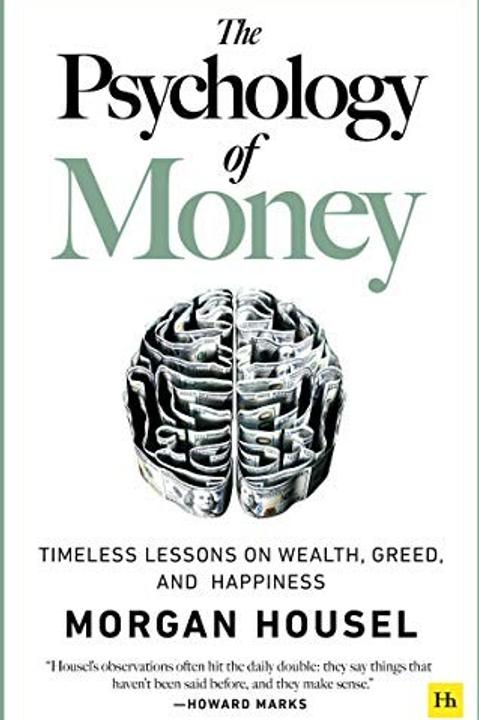
Psychology of Money Summary: 19 Lessons on Wealth & Happiness
by Morgan Housel
Why read this book
- 💰 19 counterintuitive lessons about money and behavior
- 🧠 Why financial success is 80% psychology, 20% knowledge
- 📈 Learn from both winners (Warren Buffett) and cautionary tales
- ⏰ Understand compounding, risk, and the power of long-term thinking
In one sentence
Morgan Housel's 19 counterintuitive lessons reveal why financial success is 80% psychology, 20% knowledge. Learn why doing well with money isn't about what you know—it's how you behave, how you think about risk, and how you understand compounding.
Key takeaways
- No one is crazy with money — everyone's financial decisions make sense given their unique life experiences and worldview
- Getting wealthy and staying wealthy are different skills — one requires optimism and risk-taking, the other requires humility and fear
- Compound interest is the most powerful force in finance — time in the market beats timing the market
- Wealth is what you don't see — true wealth is the money not spent, the financial options and flexibility you've accumulated
- Save money without a specific reason — financial flexibility is the most valuable thing money can buy
- Room for error is the most important part of any financial plan — things will go wrong, plan for it
- Reasonable beats rational — the best financial plan is one you can stick with, even if it's not mathematically optimal
- Your personal history creates your worldview on money — and that worldview may not match reality
Chapter-by-chapter summary
The book has 20 numbered chapters. Each summary links to the detailed notes for that chapter.
- No One's Crazy
Money decisions make more sense when you know the experiences that shaped them.
- Luck & Risk
Outcomes mix work with chance. Broad patterns teach more than extreme success or failure stories.
- Never Enough
Define what enough means before comparison and ambition keep moving the goalposts.
- Confounding Compounding
A long time horizon can matter more than finding the highest possible return.
- Getting Wealthy vs. Staying Wealthy
Building wealth rewards optimism and risk; keeping it requires saving and survival.
- Tails, You Win
A small number of winners can drive most results, even when many other attempts fail.
- Freedom
The best dividend money pays is greater control over your time.
- Man in the Car Paradox
People usually admire an expensive possession more than they admire its owner.
- Wealth is What You Don't See
Visible spending shows what was spent; wealth is the money and freedom that remain.
- Save Money
Your savings rate and expectations often matter more than your income.
- Reasonable > Rational
A financial plan you can follow is better than a perfect plan you will abandon.
- Surprise!
History cannot predict the rare events and major changes that move markets most.
- Room for Error
Extra room in a plan keeps a bad forecast from ending your ability to keep playing.
- You'll Change
Your goals will change, so avoid plans that depend on your current priorities lasting forever.
- Nothing's Free
Investment returns come with uncertainty, price swings, and regret.
- You & Me
Identify your goals and time horizon before copying someone playing a different financial game.
- The Seduction of Pessimism
Bad news arrives quickly, while progress compounds too slowly to attract the same attention.
- When You'll Believe Anything
Strong wants and missing information make financial stories easier to believe.
- All Together Now
Housel combines the book into practical rules about patience, saving, and room for error.
- Confessions
Housel explains why his own plan favours freedom and durability over a mathematically perfect return.
Free cheat sheet: 8 lessons from The Psychology of Money
A one-page printable summary of the book’s core lessons.
Summary
The most valuable part of this book is that it explicitly links personal finance with psychology.
Saving, investment strategies, decision-making—these have all been known as key parts of personal finance, but the psychological side is rarely explored, and that's what this book is about.
Reading this plus another book on the operational side of personal finance—I Will Teach You To Be Rich, for example—will put you ahead of 99% of the population on managing your money.
Who should read this
- Anyone who wants to understand why they make the financial decisions they do
- Investors looking for timeless principles rather than hot stock tips
- Young professionals starting their wealth-building journey
- People who feel anxious or confused about money and want a calmer perspective
- Those who prefer behavioral finance over technical analysis
Favorite quotes
- Spending money to show people how much money you have is the fastest way to have less money.
- The highest form of wealth is the ability to wake up every morning and say, I can do whatever I want today.
- You can be wrong half the time and still make a fortune.
- Savings without a spending goal gives you options and flexibility.
- Planning is important, but the most important part of every plan is to plan on the plan not going according to plan.
- Getting money requires taking risks, being optimistic, and putting yourself out there. But keeping money requires the opposite of taking risk.
- Wealth is created by suppressing what you could buy today in order to have more stuff or more options in the future.
- The world is full of people who look modest but are actually wealthy, and people who look rich but are barely hanging on.
FAQ
What is the main point of The Psychology of Money?
The central argument is that financial success is primarily about behavior, not intelligence or knowledge. How you behave with money is more important than what you know about money. Your personal history, emotions, and biases shape your financial decisions more than spreadsheets or rational analysis.
What are the best lessons from The Psychology of Money?
Key lessons include: understand that everyone has a different relationship with money based on their experiences; focus on not losing money rather than making money; save without a specific goal for flexibility; accept that reasonable is better than rational; and recognize that wealth is what you don't see (unspent money).
Is The Psychology of Money good for beginners?
Yes, it's one of the best books for beginners. Housel avoids jargon, focuses on timeless behavioral principles rather than specific investment strategies, and uses engaging stories to illustrate points. It's more about developing the right mindset than learning technical skills.
How does The Psychology of Money compare to other finance books?
Unlike traditional finance books that focus on numbers and strategies, this book focuses on the emotional and psychological aspects of money. It's closer to a behavioral economics book than an investing manual. It pairs well with books like "A Random Walk Down Wall Street" for technical knowledge.
What does Morgan Housel say about saving money?
Housel argues you should save money without a specific goal in mind. The value of savings is the flexibility and options it provides — the ability to wait for opportunities, handle emergencies, or change direction in life. He calls this "the ability to do what you want, when you want, with who you want."
What is the difference between getting wealthy and staying wealthy?
Housel's key insight: getting wealthy requires optimism, risk-taking, and putting yourself out there. Staying wealthy requires the opposite — pessimism, frugality, and paranoia about losing what you have. Many people are good at one but terrible at the other. The best investors combine both.
Is The Psychology of Money worth reading?
It's one of the most accessible personal finance books ever written — no jargon, no complex formulas, just clear thinking about why we make the money decisions we do. Each chapter is a standalone essay, so you can read them in any order. It's particularly valuable for people who understand finance intellectually but still make emotional money decisions.
Detailed Notes
Click to expand the full detailed notes →
Detailed Notes
Click to expand the full detailed notes →
Key Takeaways
- Financial success is far more about how you behave than what you know.
- Luck and risk play a role in almost all outcomes. Individual effort can only get you so far.
- Be careful about looking at specific examples of outcomes, and look more for general patterns.
- The hardest financial skill is getting the goalpost to stop moving. And to do that, you have to stop comparing yourself to others, and start determining what is "enough" for yourself.
- One of the single most important things you can do as an investor is wait, or extend your time horizon.
- Staying wealthy requires some combination of paranoia and frugality.
- Always plan for something to go wrong, and for some large, unexpected expense.
- Controlling your time is the highest dividend money pays.
- No one is impressed by your possessions as much as you are.
- Building wealth has little to do with your income or investment returns, and lots to do with your savings rate.
- Past a certain level of income, what you need depends only on your ego.
- Aim to be reasonable with your finances, not completely rational. This will be more realistic long-term.
- We can't predict future outlier events. That's what makes them outliers. So factor it into your plan.
- You need to add room for error, and avoid financial ruin. Leverage—going into debt—pushes routine risk into potential for ruin.
- Assume your priorities will change in the future, and avoid the extremes of financial planning. Examples include assuming you'll be happy with very low income, or willing to work very long hours for higher income.
- Everything has a price. The price of immediate consumption is much more visible than the price of neglecting long-term investment.
- Know what game you are playing, and avoid taking financial cues from people playing a different game.
- Stories are the most powerful force in the economy. Beware the stories you tell yourself.
- Short takes:
- Less ego, more wealth.
- Use money to gain control of your time.
- Be nicer and less flashy.
- Save.
- Worship room for error.
- Avoid extremes.
Notes
Introduction: The Greatest Show On Earth
- One, financial outcomes are driven by luck, independent of intelligence and effort. That’s true to some extent, and this book will discuss it in further detail.
- Or, two (and I think more common), that financial success is not a hard science. It’s a soft skill, where how you behave is more important than what you know.
1. No One's Crazy
- Your personal experiences with money make up maybe 0.00000001% of what's happened in the world, but maybe 80% of how you think the world works.
- The 401(k)—the backbone savings vehicle of American retirement—did not exist until 1978. The Roth IRA was not born until 1998. If it were a person it would be barely old enough to drink.
2. Luck & Risk
- Nothing is as good or as bad as it seems.
- Luck and risk are both the reality that every outcome in life is guided by forces other than individual effort. They are so similar that you can’t believe in one without equally respecting the other.
- Be careful when assuming that 100% of outcomes can be attributed to effort and decisions.
- Focus less on specific individuals and case studies and more on broad patterns.
- Studying a specific person can be dangerous because we tend to study extreme examples—the billionaires, the CEOs, or the massive failures that dominate the news—and extreme examples are often the least applicable to other situations, given their complexity. The more extreme the outcome, the less likely you can apply its lessons to your own life, because the more likely the outcome was influenced by extreme ends of luck or risk.
- The trick when dealing with failure is arranging your financial life in a way that a bad investment here and a missed financial goal there won’t wipe you out so you can keep playing until the odds fall in your favor.
3. Never Enough
1. The hardest financial skill is getting the goalpost to stop moving.
- Modern capitalism is a pro at two things: generating wealth and generating envy.
- Happiness, as it’s said, is just results minus expectations.
2. Social comparison is the problem here.
- The point is that the ceiling of social comparison is so high that virtually no one will ever hit it. Which means it’s a battle that can never be won, or that the only way to win is to not fight to begin with—to accept that you might have enough, even if it’s less than those around you.
3. “Enough” is not too little.
- The idea of having “enough” might look like conservatism, leaving opportunity and potential on the table.
- “Enough” is realizing that the opposite—an insatiable appetite for more—will push you to the point of regret.
4. There are many things never worth risking, no matter the potential gain
- Reputation is invaluable.
- Freedom and independence are invaluable.
- Family and friends are invaluable.
- Being loved by those who you want to love you is invaluable.
- Happiness is invaluable.
- And your best shot at keeping these things is knowing when it’s time to stop taking risks that might harm them. Knowing when you have enough.
4. Confounding Compounding
- $81.5 billion of Warren Buffett's $84.5 billion net worth came after his 65th birthday. Our minds are not built to handle such absurdities.
- Warren Buffett is a phenomenal investor. But you miss a key point if you attach all of his success to investing acumen. The real key to his success is that he’s been a phenomenal investor for three quarters of a century. Had he started investing in his 30s and retired in his 60s, few people would have ever heard of him.
5. Getting Wealthy vs. Staying Wealthy
- Good investing is not necessarily about making good decisions. It's about consistently not screwing up.
- But there’s only one way to stay wealthy: some combination of frugality and paranoia.
1. More than I want big returns, I want to be financially unbreakable. And if I’m unbreakable I actually think I’ll get the biggest returns, because I’ll be able to stick around long enough for compounding to work wonders.
2. Planning is important, but the most important part of every plan is to plan on the plan not going according to plan.
3. A barbelled personality—optimistic about the future, but paranoid about what will prevent you from getting to the future—is vital.
6. Tails, You Win
- You can be wrong half the time and still make a fortune.
- A lot of things in business and investing work this way. Long tails—the farthest ends of a distribution of outcomes—have tremendous influence in finance, where a small number of events can account for the majority of outcomes.
- Anything that is huge, profitable, famous, or influential is the result of a tail event—an outlying one-in-thousands or millions event. And most of our attention goes to things that are huge, profitable, famous, or influential. When most of what we pay attention to is the result of a tail, it’s easy to underestimate how rare and powerful they are.
7. Freedom
- Controlling your time is the highest dividend money pays.
- The highest form of wealth is the ability to wake up every morning and say, “I can do whatever I want today.”
- Campbell wanted to know what made people happy. His 1981 book, The Sense of Wellbeing in America, starts by pointing out that people are generally happier than many psychologists assumed
The most powerful common denominator of happiness was simple. Campbell summed it up:
- Having a strong sense of controlling one’s life is a more dependable predictor of positive feelings of wellbeing than any of the objective conditions of life we have considered.
- Money’s greatest intrinsic value—and this can’t be overstated—is its ability to give you control over your time.
8. Man in the Car Paradox
- No one is impressed with your possessions as much as you are.
9. Wealth is What You Don't See
- Spending money to show people how much money you have is the fastest way to have less money.
- It is excellent advice, but it may not go far enough. The only way to be wealthy is to not spend the money that you do have. It’s not just the only way to accumulate wealth; it’s the very definition of wealth.
10. Save Money
- The only factor you can control generates one of the only things that matters. How wonderful.
- The first idea—simple, but easy to overlook—is that building wealth has little to do with your income or investment returns, and lots to do with your savings rate.
- More importantly, the value of wealth is relative to what you need.
- Past a certain level of income, what you need is just what sits below your ego.
- Think of it like this, and one of the most powerful ways to increase your savings isn’t to raise your income. It’s to raise your humility.
- Intelligence is not a reliable advantage in a world that’s become as connected as ours has.
- But flexibility is.
- If you have flexibility you can wait for good opportunities, both in your career and for your investments. You’ll have a better chance of being able to learn a new skill when it’s necessary. You’ll feel less urgency to chase competitors who can do things you can’t, and have more leeway to find your passion and your niche at your own pace. You can find a new routine, a slower pace, and think about life with a different set of assumptions. The ability to do those things when most others can’t is one of the few things that will set you apart in a world where intelligence is no longer a sustainable advantage.
11. Reasonable > Rational
- Aiming to be mostly reasonable works better than trying to be coldly rational.
- With it comes something that often goes overlooked: Do not aim to be coldly rational when making financial decisions. Aim to just be pretty reasonable. Reasonable is more realistic and you have a better chance of sticking with it for the long run, which is what matters most when managing money.
12. Surprise!
- History is the study of change, ironically used as a map of the future.
- Two dangerous things happen when you relly too heavily on investment history as a guide to what's going to happen next.
- You'll likely miss the outlier events that move the needle the most.
2. History can be a misleading guide to the future of the economy and stock market because it doesn’t account for structural changes that are relevant to today’s world.
13. Room for Error
- The most important part of every plan is planning on your plan not going according to plan.
- Benjamin Graham is known for his concept of margin of safety. He wrote about it extensively and in mathematical detail. But my favorite summary of the theory came when he mentioned in an interview that “the purpose of the margin of safety is to render the forecast unnecessary.”
- “The best way to achieve felicity is to aim low,” says Charlie Munger (felicity = happiness, bliss). Wonderful.
- Leverage is the devil here. Leverage—taking on debt to make your money go further—pushes routine risks into something capable of producing ruin. The danger is that rational optimism most of the time masks the odds of ruin some of the time
- If there’s one way to guard against their damage, it’s avoiding single points of failure.
14. You'll Change
- Long-term planning is harder than it seems because people's goals and desires change over time.
- The End of History Illusion is what psychologists call the tendency for people to be keenly aware of how much they’ve changed in the past, but to underestimate how much their personalities, desires, and goals are likely to change in the future.
- We should avoid the extreme ends of financial planning. Assuming you’ll be happy with a very low income, or choosing to work endless hours in pursuit of a high one, increases the odds that you’ll one day find yourself at a point of regret.
- Aiming, at every point in your working life, to have moderate annual savings, moderate free time, no more than a moderate commute, and at least moderate time with your family, increases the odds of being able to stick with a plan and avoid regret than if any one of those things fall to the extreme sides of the spectrum.
- Sunk costs—anchoring decisions to past efforts that can’t be refunded—are a devil in a world where people change over time.
15. Nothing's Free
- Everything has a price, but not all prices appear on labels.
- The question is: Why do so many people who are willing to pay the price of cars, houses, food, and vacations try so hard to avoid paying the price of good investment returns?
- The answer is simple: The price of investing success is not immediately obvious.
16. You & Me
- Beware taking financial cues from people playing a different game than you are.
- An iron rule of finance is that money chases returns to the greatest extent that it can.
- Bubbles do their damage when long-term investors playing one game start taking their cues from those short-term traders playing another.
- So much consumer spending, particularly in developed countries, is socially driven: subtly influenced by people you admire, and done because you subtly want people to admire you.
- But while we can see how much money other people spend on cars, homes, clothes, and vacations, we don’t get to see their goals, worries, and aspirations. A young lawyer aiming to be a partner at a prestigious law firm might need to maintain an appearance that I, a writer who can work in sweatpants, have no need for. But when his purchases set my own expectations, I’m wandering down a path of potential disappointment because I’m spending the money without the career boost he’s getting. We might not even have different styles. We’re just playing a different game. It took me years to figure this out.
- A takeaway here is that few things matter more with money than understanding your own time horizon and not being persuaded by the actions and behaviors of people playing different games than you are.
- The main thing I can recommend is going out of your way to identify what game you’re playing.
17. The Seduction of Pessimism
- Optimism sounds like a sales pitch. Pessimism sounds like someone trying to help you.
- “For reasons I have never understood, people like to hear that the world is going to hell.”—Historian Deirdre McCloskey
- Pessimism just sounds smarter and more plausible than optimism.
- One is that money is ubiquitous, so something bad happening tends to affect everyone and captures everyone’s attention.
- Another is that pessimists often extrapolate present trends without accounting for how markets adapt.
- There is an iron law in economics: extremely good and extremely bad circumstances rarely stay that way for long because supply and demand adapt in hard-to-predict ways.
- A third is that progress happens too slowly to notice, but setbacks happen too quickly to ignore.
- Growth is driven by compounding, which always takes time. Destruction is driven by single points of failure, which can happen in seconds, and loss of confidence, which can happen in an instant.
18. When You'll Believe Anything
- Stories are, by far, the most powerful force in the economy.
1. The more you want something to be true, the more likely you are to believe a story that overestimates the odds of it being true.
2. Everyone has an incomplete view of the world. But we form a complete narrative to fill in the gaps.
Kahneman once laid out the path these stories take:
- When planning we focus on what we want to do and can do, neglecting the plans and skills of others whose decisions might affect our outcomes.
- Both in explaining the past and in predicting the future, we focus on the causal role of skill and neglect the role of luck.
- We focus on what we know and neglect what we do not know, which makes us overly confident in our beliefs.
19. All Together Now
- What we've learned about the psychology of your own money.
- Go out of your way to find humility when things are going right and forgiveness/compassion when they go wrong. Because it’s never as good or as bad as it looks.
- Respect the power of luck and risk and you’ll have a better chance of focusing on things you can actually control. You’ll also have a better chance of finding the right role models.
- Less ego, more wealth. Saving money is the gap between your ego and your income, and wealth is what you don’t see.
- Manage your money in a way that helps you sleep at night.
- If you want to do better as an investor, the single most powerful thing you can do is increase your time horizon.
- Become OK with a lot of things going wrong.
- Use money to gain control over your time, because not having control of your time is such a powerful and universal drag on happiness.
- Be nicer and less flashy. No one is impressed with your possessions as much as you are.
- Save. Just save. You don’t need a specific reason to save.
- Define the cost of success and be ready to pay it. Because nothing worthwhile is free. And remember that most financial costs don’t have visible price tags. Uncertainty, doubt, and regret are common costs in the finance world.
- Worship room for error.
- Avoid the extreme ends of financial decisions.
- You should like risk because it pays off over time. But you should be paranoid of ruinous risk because it prevents you from taking future risks that will pay off over time.
- Define the game you’re playing, and make sure your actions are not being influenced by people playing a different game.
- Respect the mess. Smart, informed, and reasonable people can disagree in finance, because people have vastly different goals and desires. There is no single right answer; just the answer that works for you.
20. Confessions
- We can leave aside rich, but independence has always been my personal financial goal.
- Independence, at any income level, is driven by your savings rate.
- If there’s a part of our household financial plan I’m proud of it’s that we got the goalpost of lifestyle desires to stop moving at a young age.
- We own our house without a mortgage, which is the worst financial decision we’ve ever made but the best money decision we’ve ever made. Mortgage interest rates were absurdly low when we bought our house. Any rational advisor would recommend taking advantage of cheap money and investing extra savings in higher-return assets, like stocks. But our goal isn’t to be coldly rational; just psychologically reasonable.
- Everything I’ve learned about personal finance tells me that everyone—without exception—will eventually face a huge expense they did not expect—and they don’t plan for these expenses specifically because they did not expect them.
- If I had to summarize my views on investing, it’s this: Every investor should pick a strategy that has the highest odds of successfully meeting their goals. And I think for most investors, dollar-cost averaging into a low-cost index fund will provide the highest odds of long-term success.
- One of my deeply held investing beliefs is that there is little correlation between investment effort and investment results. The reason is because the world is driven by tails—a few variables account for the majority of returns.
Postscript: A Brief History of Why the U.S. Consumer Thinks the Way They Do
- Everything in finance is data within the context of expectations.
- All that matters is that sharp inequality became a force over the last 35 years, and it happened during a period where, culturally, Americans held onto two ideas rooted in the post-WW2 economy: That you should live a lifestyle similar to most other Americans, and that taking on debt to finance that lifestyle is acceptable.